
Choosing between quartz vs porcelain countertops in Toronto is one of the most consequential decisions GTA homeowners make during a kitchen or bathroom renovation, and in 2026 the gap between the two materials has narrowed in price while widening in performance differences. Both surfaces are engineered, both look stunning in a modern Toronto home, and both carry very different strengths once you start cooking, entertaining, and living with them day to day. This guide breaks down real 2026 pricing from GTA fabricators, durability under Canadian conditions, installation timelines, and exactly where to buy, so you can specify the right slab the first time.
At Red Stone Contracting, we install both materials across Toronto, Mississauga, Burlington and the wider GTA every week, and the “best” choice almost always comes down to how you use the space rather than which surface is objectively superior. A west-end family that bakes daily has different needs than a downtown condo owner chasing a seamless waterfall island. Let’s get into the specifics.
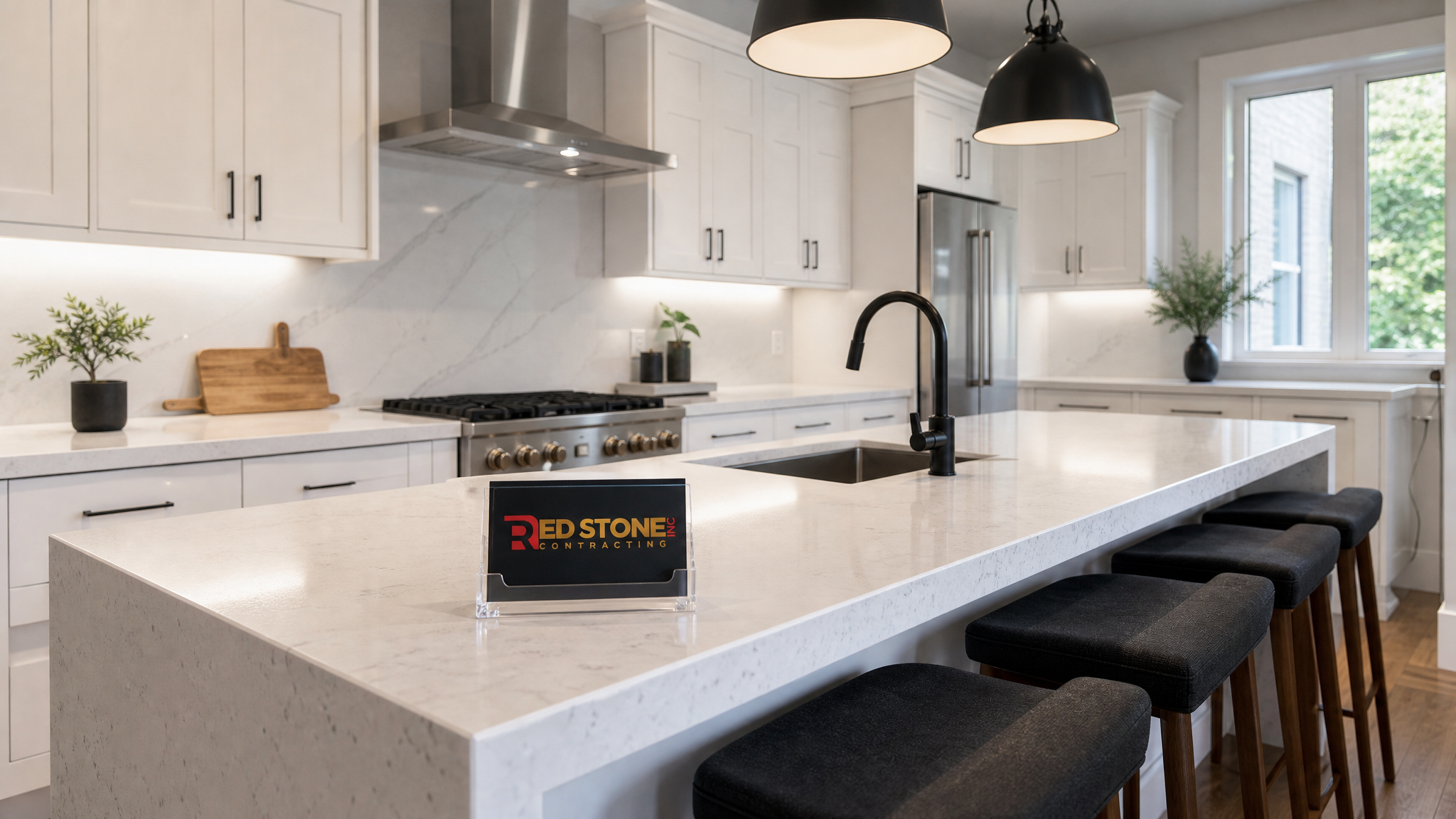
Quartz vs Porcelain Countertops in Toronto: What Each Material Actually Is
Before comparing quartz vs porcelain countertops Toronto buyers should understand that neither is a natural stone slab pulled from a quarry. Engineered quartz is roughly 90-93% ground natural quartz crystals bound with polymer resins and pigments, then cured into rigid slabs. Brands common in the GTA include Caesarstone, Silestone, Cambria, and Hanstone. The resin content is what gives quartz its non-porous, consistent surface, but it is also why quartz has a heat ceiling.
Porcelain countertops are large-format sintered slabs made from natural clays, feldspar, silica and mineral oxides fired at temperatures above 1,200 degrees Celsius. The result is an ultra-dense, fully vitrified surface, typically only 6mm to 12mm thick, often with a printed and glazed top layer that mimics marble, concrete or stone. Dekton (technically sintered stone), Neolith, Florim and Laminam are the names you will see quoted by Toronto fabricators.
The practical headline: quartz is thicker, warmer-feeling, and forgiving to fabricate, while porcelain is thinner, harder, completely heat- and UV-proof, but more demanding to cut and install. Those fundamentals drive every cost and durability difference below. Whether you are planning a full kitchen renovation or a focused bathroom renovation, the material choice cascades into cabinetry, support framing, and budget.
2026 Toronto Cost Comparison: Quartz vs Porcelain Per Square Foot
Pricing in the GTA is quoted installed (material, fabrication, templating, and installation) per square foot. The figures below reflect 2026 fabricator quotes across Toronto, Mississauga and Burlington. Porcelain material itself can be competitive, but specialised cutting, thin-slab handling, and edge build-up frequently push the installed price above mid-range quartz.
| Surface (installed) | 2026 GTA price / sq ft | Typical kitchen (45 sq ft) installed | Lead time |
|---|---|---|---|
| Builder-grade quartz | $65 – $90 | $2,925 – $4,050 | 1 – 2 weeks |
| Mid-range designer quartz | $90 – $130 | $4,050 – $5,850 | 2 – 3 weeks |
| Premium quartz (Cambria, marble-look) | $130 – $180 | $5,850 – $8,100 | 2 – 4 weeks |
| Porcelain / sintered slab | $110 – $200 | $4,950 – $9,000 | 3 – 5 weeks |
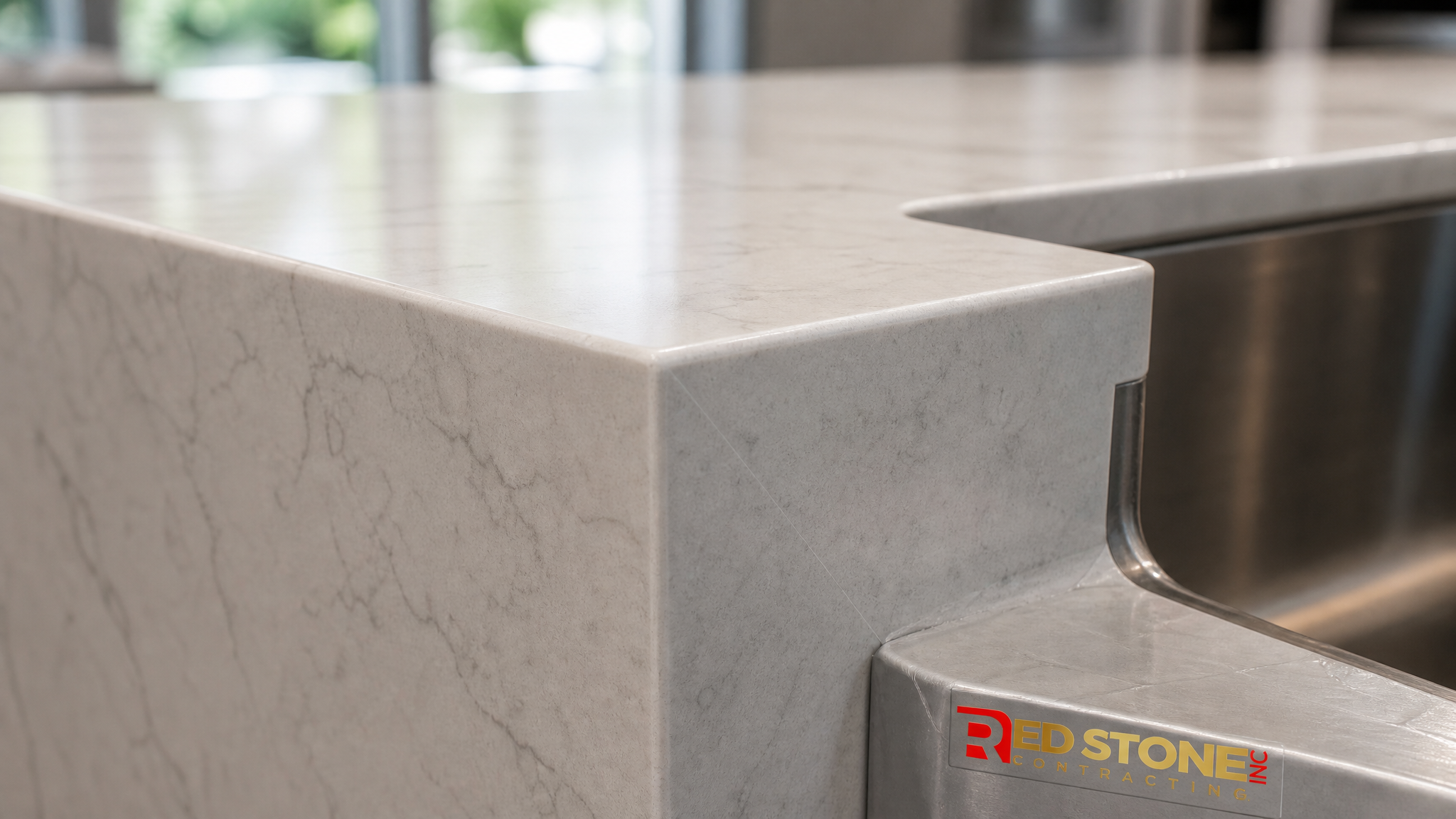
Two cost drivers catch GTA homeowners off guard. First, edge profiles: a porcelain countertop that needs a thick “mitred” edge to look like a 2-inch slab requires gluing two pieces at 45 degrees, adding labour. Second, waterfall islands and seamless sinks add $400 to $1,500 depending on material. The table below isolates these add-ons.
| Add-on / upgrade | Quartz cost (2026) | Porcelain cost (2026) | Notes |
|---|---|---|---|
| Mitred waterfall edge (per side) | $350 – $600 | $500 – $900 | Porcelain mitre is labour-intensive |
| Undermount sink cutout | $150 – $250 | $250 – $400 | Porcelain needs CNC + reinforcement |
| Full-height backsplash (per sq ft) | $60 – $100 | $90 – $160 | Porcelain book-matching is premium |
| Integrated cooktop / flush mount | $200 – $400 | $300 – $550 | Heat tolerance favours porcelain |
For a realistic GTA budget, a mid-sized kitchen with a waterfall island and full-height backsplash typically lands at $5,500 to $8,000 in quartz and $7,500 to $12,000 in porcelain once all add-ons are counted. We always recommend folding the countertop allowance into the broader project scope during design solutions planning so there are no surprises at slab selection.
Durability Head to Head: Heat, Scratches, Stains and UV
This is where quartz vs porcelain countertops genuinely diverge, and where many Toronto homeowners change their mind once they see the data. Porcelain wins decisively on heat and UV; quartz wins on impact resilience and edge durability. Neither is indestructible, but each fails in predictable ways.
| Performance factor | Quartz | Porcelain | Winner |
|---|---|---|---|
| Heat resistance | Up to ~150 C, resin scorches | Up to ~1,000 C, place hot pans directly | Porcelain |
| Scratch resistance | 7 on Mohs scale | 7 – 8 on Mohs scale | Porcelain (slight) |
| Stain resistance | Excellent, non-porous | Excellent, non-porous | Tie |
| UV / fade resistance | Can yellow in direct sun | UV-stable, suitable outdoors | Porcelain |
| Chip / impact resistance | Strong, thick body | Edges can chip on impact | Quartz |
The heat story is the single biggest reason GTA buyers choose porcelain in 2026. A quartz countertop can scorch or develop a permanent white “burn ring” if you set a 230-degree cast-iron pan straight off the stove onto it, because the resin binder degrades. Porcelain shrugs that off entirely. Conversely, porcelain’s thin profile means a dropped heavy stockpot near an unsupported edge can chip a small crater, whereas thick quartz absorbs the blow.
For sunrooms, home additions with south-facing glazing, or any outdoor kitchen, porcelain is the clear specification because quartz resin yellows under sustained UV exposure. Inside a typical north Toronto kitchen with normal daylight, quartz fading is rarely an issue over a 15-year horizon.
Installation, Lead Times and Why Fabrication Matters
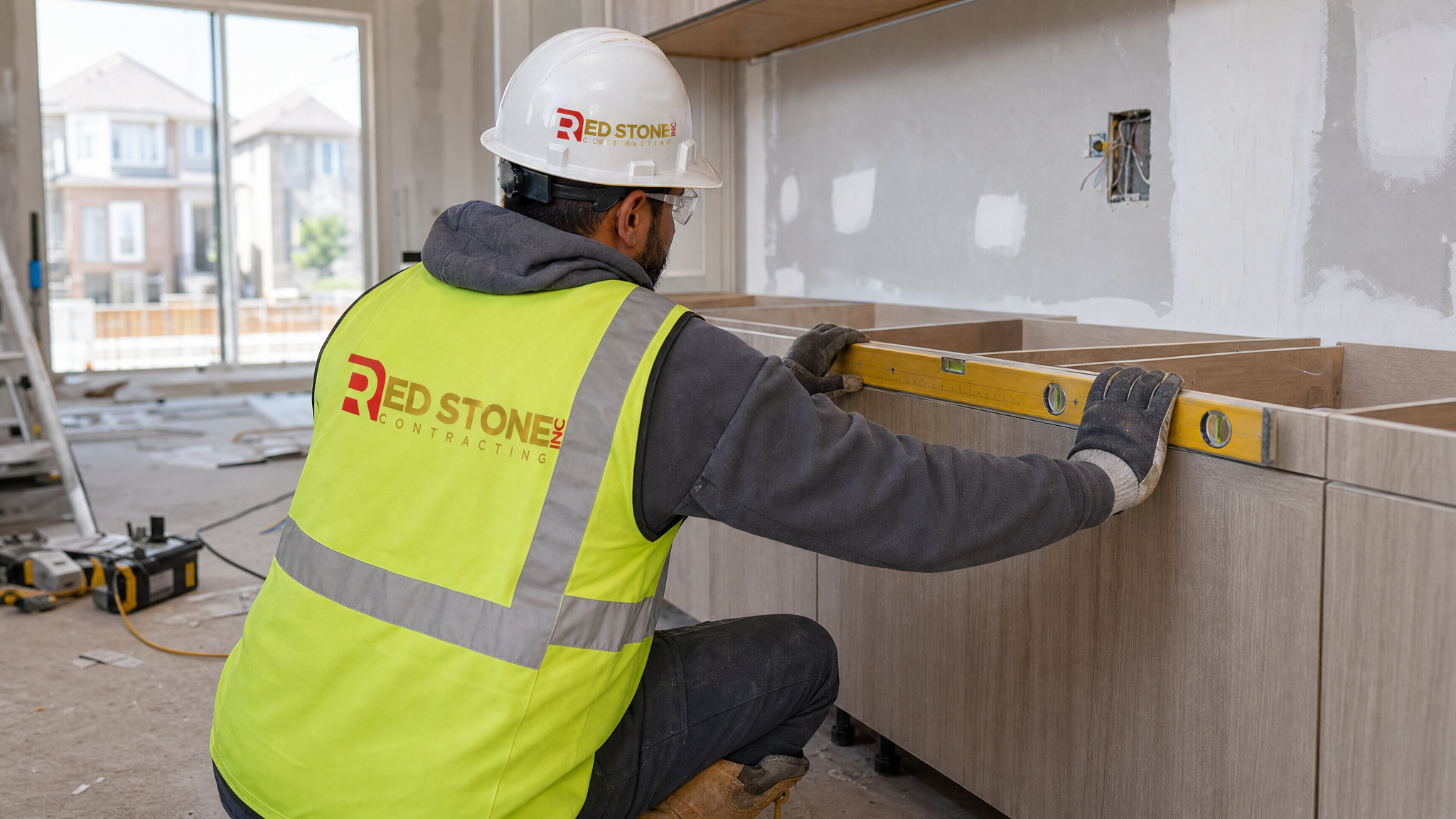
The material is only half the equation; fabrication and installation determine whether your countertop looks flawless or shows a telltale seam. Quartz is the more forgiving material to template, cut and install, which is part of why its installed price is often lower than porcelain despite similar raw material costs.
Porcelain requires CNC waterjet or bridge saws with continuous water cooling, diamond tooling, and crews trained specifically in thin-slab handling. A 3-metre porcelain slab at 6mm thick can crack if lifted incorrectly. This is why we strongly caution Toronto homeowners against bargain installers for porcelain: a botched cut on a $3,000 slab is an expensive lesson.
| Project phase | Quartz timeline | Porcelain timeline | What happens |
|---|---|---|---|
| Templating after cabinet install | Day 1 | Day 1 | Laser or digital template taken |
| Fabrication | 5 – 10 business days | 10 – 18 business days | Cutting, edging, polishing |
| Installation on site | 3 – 5 hours | 4 – 8 hours | Set, level, seam, seal joints |
| Sink / plumbing reconnect | Same day – next day | Same day – next day | Coordinated with plumber |
A key GTA-specific note: countertops are templated only after cabinets are installed and level, so countertop selection sits late in a renovation sequence. Building that lead time into the schedule prevents a finished kitchen sitting countertop-less for three weeks. Our project managers coordinate templating across our Toronto renovation services so trades do not collide. The same discipline applies to basement wet bars and secondary kitchens during a basement renovation.
Where to Buy Quartz and Porcelain Countertops in the GTA
Toronto and the surrounding region have a deep network of suppliers, fabricators and showrooms. Homeowners generally buy through one of three channels: a big-box retailer (convenient, limited slab choice), a dedicated stone yard (widest selection, you pick your exact slab), or directly through your renovation contractor (turnkey, single point of accountability). The table below summarises the practical trade-offs.
| Buying channel | Selection | Best for | Considerations |
|---|---|---|---|
| Stone yards / slab galleries (Concord, Vaughan, Mississauga) | Hundreds of slabs, hand-pick yours | Premium quartz, book-matched porcelain | Need a fabricator to cut; coordinate logistics |
| Big-box retailers | Limited curated lines | Builder-grade quartz, fast turnaround | Less control over slab veining |
| Through your contractor | Access to trade accounts + yards | Full renovations, single warranty | One accountable party for fit and finish |
| Direct importers | Porcelain / sintered specialists | Large-format porcelain, outdoor | Verify fabrication capability |
For a whole-home project, buying through your contractor is usually the lowest-risk route because trade accounts often beat retail pricing, and a single firm warranties both the slab fit and the surrounding cabinetry and tile. When we handle a custom home renovation in Burlington or Mississauga, we accompany clients to the slab yard so they hand-select the exact piece that becomes their island, then we manage fabrication and install end to end through our Mississauga renovation services and Burlington renovation services teams.
Which Surface Should You Choose for Your Toronto Home?
There is no universal winner; there is a winner for your situation. Below is the decision framework we walk GTA clients through. If you cook with high heat constantly, work near direct sunlight, or want an outdoor kitchen, porcelain earns its premium. If you want a thick, warm, forgiving surface with the widest colour range and a softer price, quartz is the pragmatic choice for most Toronto kitchens.
- Choose porcelain if: you place hot cookware directly on the surface, you have a sun-drenched space or outdoor kitchen, you want a thin minimalist 6mm look, or you crave authentic large-format marble visuals without natural stone maintenance.
- Choose quartz if: you want the broadest colour and pattern selection, a thicker substantial slab, slightly lower installed cost, and a more forgiving material that resists edge chipping and is easier to repair.
- Either works if: stain resistance and low maintenance are your priorities, since both are non-porous and never need sealing like natural granite or marble.
One more GTA reality: resale. In Toronto’s competitive 2026 market, both quartz and porcelain read as premium upgrades to buyers, far ahead of laminate or tile. The renovation value is captured by having a flawless, seam-conscious installation, which is precisely why fabrication and contractor selection matter more than agonising over the brand of slab.
Frequently Asked Questions
Is porcelain more expensive than quartz in Toronto?
Can you put hot pans directly on quartz or porcelain?
Which lasts longer, quartz or porcelain countertops?
Do quartz or porcelain countertops need sealing?
How long does countertop installation take in the GTA?
Is porcelain good for outdoor kitchens in Toronto’s climate?
Get Expert Help Choosing Quartz vs Porcelain Countertops in Toronto
The smartest way to decide between quartz vs porcelain countertops in Toronto is to plan the surface alongside your full renovation scope rather than treating it as an afterthought. Red Stone Contracting guides GTA homeowners from slab selection through fabrication and flawless installation, so your countertop fits your lifestyle, your cabinetry and your budget.
Call us today at (905) 901-1006 or request a free consultation to walk through your kitchen or bathroom project with an experienced team.
Red Stone Contracting proudly serves homeowners across Toronto, Mississauga, Burlington and the Greater Toronto Area with expert home renovation, design and countertop installation.