
If you are planning a renovation in 2026, the single most confusing moment of the entire project arrives before a hammer is ever swung: the day three estimates land in your inbox and they are thousands of dollars apart. Learning how to compare renovation quotes Toronto homeowners receive is not about chasing the lowest number, it is about understanding why the numbers differ, what each line item actually buys you, and which omissions signal a contractor who will hit you with change orders later. A $48,000 kitchen quote and a $71,000 kitchen quote can describe the exact same room, and the cheaper one is frequently the more expensive choice once the dust settles.
This guide walks through reading a GTA contractor estimate line by line, decoding the pricing structures used across Toronto, Mississauga and Burlington, and spotting the red flags that separate a professional bid from a problem waiting to happen. Whether you are renovating a Leslieville kitchen, finishing a Mississauga basement, or adding a second storey in Burlington, the framework below applies.

Why You Need at Least Three Quotes Before You Compare Renovation Quotes Toronto Contractors Send
The reason a single estimate is dangerous is that you have no benchmark. When you compare renovation quotes Toronto contractors prepare, you are really comparing three different interpretations of the same scope, and the spread tells a story. A tight cluster (say, three bids within 10 percent of each other) usually means the scope is well defined and the market price is honest. A wild spread, where the high bid is 50 percent above the low one, almost always means the contractors are pricing different work, not the same work at different margins.
In the 2026 GTA market, material costs have stabilised somewhat after the volatility of prior years, but labour remains the swing factor. A licensed crew with WSIB coverage, liability insurance and a permit-pulling track record cannot match the price of a cash operator working off the books, and that gap is exactly what you are trying to detect. The lowest bid is not a bargain if it excludes permits, disposal, or the electrical upgrade your 1960s Etobicoke panel will require.
| Quote spread | Most likely meaning | Your next move |
|---|---|---|
| Within 10% | Scope is clear; honest market pricing | Compare inclusions and warranty, then decide |
| 15% to 30% | Different allowances or material grades | Line up the line items and ask what differs |
| 30% to 50% | One bid likely omits major scope | Find the missing items before choosing |
| Over 50% | Lowball bid, missing permits or insurance | Treat the low number as a red flag, not a win |
The Anatomy of a Professional GTA Estimate
A credible estimate from a GTA renovation firm reads like a small contract, not a single lump sum scribbled on a quote pad. Before you can compare anything, every bid needs to be normalised into the same categories. A proper estimate from a company like Red Stone Contracting separates demolition, structural work, mechanical trades (plumbing, electrical, HVAC), finishes, fixtures, permits and project management so you can see where the money goes.
The categories below are what a complete estimate should contain. If a bid is missing two or more of these, it is not a cheaper quote, it is an incomplete one. Whether you are pricing a kitchen renovation or a full basement renovation, the skeleton is identical.
| Estimate section | What it should specify | Red flag if missing |
|---|---|---|
| Scope of work | Room-by-room description of what is being built | Vague “renovate kitchen” with no detail |
| Demolition and disposal | Bin rental, dump fees, who hauls debris | No disposal line; surprise charge later |
| Permits and drawings | Who pulls permits and pays fees | “Owner to obtain permits” buried in fine print |
| Allowances | Dollar figures for tile, fixtures, cabinets | No allowances, so any selection triggers a change order |
| Payment schedule | Deposit plus milestone draws | Large upfront deposit (over 30%) |
| Warranty | Workmanship period in writing | No warranty mentioned at all |
Allowances, the Line Item That Hides the Real Price
Allowances are where two quotes that look identical diverge by tens of thousands of dollars. An allowance is a placeholder budget for an item you have not chosen yet, such as tile, faucets, countertops or light fixtures. If Contractor A budgets $45 per square foot for tile and Contractor B budgets $12, their bottom lines will differ even though both wrote the word “tile” on the page. When you select the porcelain you actually want, the low-allowance bid balloons through change orders.
The fix is simple but tedious: ask every contractor to list their allowances in dollars, then normalise them to the same figures before you compare. Below are realistic 2026 GTA allowance ranges that a well-prepared homeowner should expect to see. Use them to sanity-check whether a quote is padding or starving the allowances to game the total.
| Item | Builder-grade allowance | Mid-range allowance | Premium allowance |
|---|---|---|---|
| Floor tile (per sq ft, supply) | $3 to $6 | $8 to $15 | $18 to $40+ |
| Kitchen cabinets (linear ft) | $250 to $400 | $500 to $850 | $1,000 to $2,000+ |
| Countertops (per sq ft, installed) | $45 to $65 | $70 to $110 | $120 to $250+ |
| Plumbing fixtures (per bathroom) | $800 to $1,500 | $2,000 to $4,000 | $5,000 to $10,000+ |
| Interior doors (each, installed) | $180 to $300 | $350 to $550 | $600 to $1,200 |
Reading the Pricing Structure: Fixed Price vs Cost-Plus vs Time and Materials
GTA contractors quote under three broad structures, and you cannot fairly compare two estimates built on different models. A fixed-price bid puts the risk on the contractor and gives you certainty, but it tends to carry a contingency cushion. A cost-plus arrangement (you pay actual costs plus a management fee, typically 10 to 20 percent) is transparent but open-ended. Time-and-materials is common for smaller jobs and repairs but dangerous for large scopes because there is no ceiling.
For most full-room renovations and home additions, a fixed-price contract with clearly stated allowances is the safest structure for a homeowner. The key is to confirm which model each contractor used so you are not comparing a capped number against an uncapped estimate. A bid that looks cheap may simply be a time-and-materials guess with no commitment behind it.
| Structure | Who carries cost risk | Best suited for | Watch out for |
|---|---|---|---|
| Fixed price | Contractor | Defined-scope full renovations | Change orders if scope shifts |
| Cost-plus | Homeowner | Custom, evolving high-end builds | No firm ceiling on total cost |
| Time and materials | Homeowner | Small repairs, unknown conditions | Open-ended hours, no cap |
| Unit pricing | Shared | Repetitive work (flooring, tiling) | Quantity estimates can run over |
The 11 Red Flags That Should Make You Walk Away
Once your three estimates are normalised, the comparison becomes a hunt for warning signs. Some red flags are about price, but the most damaging ones are about process, paperwork and pressure. The list below reflects the recurring problems GTA homeowners report after a renovation goes wrong, and any one of them is reason to slow down and ask hard questions.
- No WSIB clearance or liability insurance. If a worker is injured on an uninsured job site, you can be held liable. Always ask for a current WSIB clearance certificate and proof of insurance.
- Cash-only or large upfront deposit. A deposit above 30 percent, or pressure to pay in cash to “save the tax”, signals cash-flow problems or tax avoidance you do not want to be part of.
- No written scope of work. A verbal handshake or a one-line quote leaves every dispute to memory.
- “Permits not required.” Structural changes, plumbing relocations and electrical work almost always need a Toronto, Mississauga or Burlington building permit. Skipping them risks orders to remove work and problems at resale.
- Allowances missing or suspiciously low. The classic setup for change-order surprises.
- No fixed start and completion dates. “We will get to it” is not a schedule.
- Pressure to sign today. A “this price expires tonight” tactic is a sales technique, not a market reality.
- No references or recent local addresses. A legitimate GTA firm can point you to finished projects nearby.
- Vague change-order policy. You want a written process and unit rates agreed up front.
- No warranty in writing. Reputable firms back workmanship for one to several years.
- The bid is dramatically below the others. If two quotes are near $60,000 and one is $38,000, the cheap one is missing something.
A thoughtful design solutions conversation up front eliminates most of these flags, because a clearly drawn and specified project leaves far less room for the ambiguity that lowball bidders exploit.
What a Realistic 2026 Renovation Costs Across the GTA
To judge whether any single quote is reasonable, you need market context. Costs vary by municipality, by the age and condition of the home, and by finish level, but the ranges below reflect typical 2026 pricing for renovations in Toronto, Mississauga and Burlington. These are turnkey ranges including labour, materials, permits and project management for a mid-range finish, not bare-bones or luxury extremes.
| Project type | Typical 2026 GTA range | Typical timeline | Permit usually required |
|---|---|---|---|
| Mid-range kitchen renovation | $45,000 to $90,000 | 6 to 10 weeks | Often (electrical, plumbing) |
| Full bathroom renovation | $22,000 to $45,000 | 3 to 6 weeks | Usually |
| Basement finishing | $45,000 to $95,000 | 8 to 14 weeks | Yes |
| Second-storey addition | $280,000 to $500,000+ | 5 to 9 months | Yes |
| Whole-home renovation | $200,000 to $600,000+ | 6 to 12 months | Yes |
If you are weighing a bathroom project, our bathroom renovation work follows the same transparent estimating approach, and for larger projects a custom home renovation demands an even more detailed estimate because the number of trades and the permit complexity multiply.
How to Normalise and Score Three Quotes Like a Pro
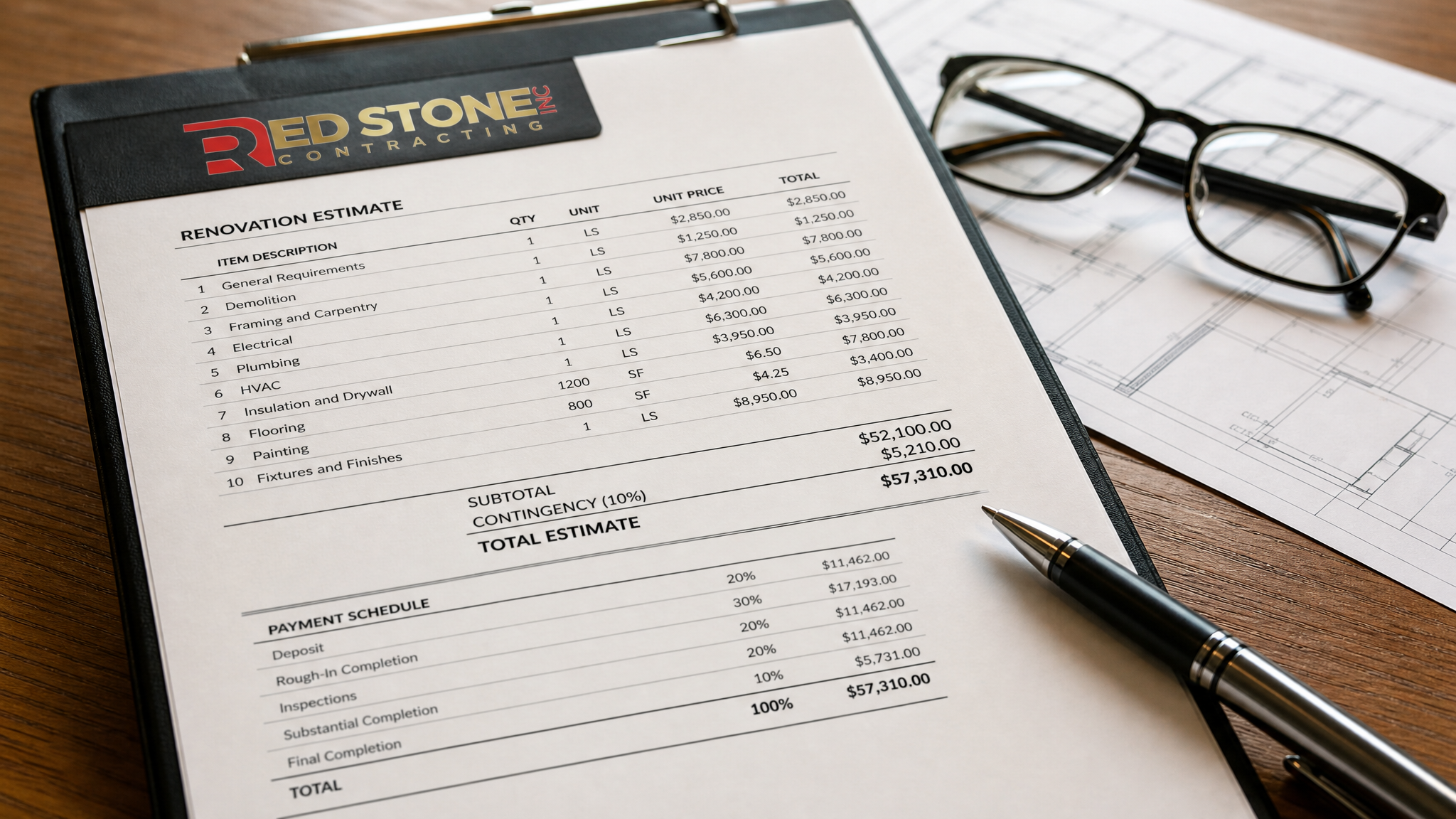
The professional way to compare renovation quotes Toronto contractors send is to build a simple side-by-side scorecard. Strip each bid down to identical categories, force the allowances to match, and only then look at the totals. Once the apples-to-apples adjustment is done, the cheapest reputable bid is usually the right one, but it is rarely the cheapest bid as originally written.
Score each contractor across the factors that actually predict a smooth project, not just price. Weight insurance, references, written scope and warranty heavily, because a slightly higher price from a firm that finishes on time and stands behind its work is far cheaper than a “bargain” that stalls halfway through. Homeowners in our Mississauga renovation services and Burlington renovation services areas consistently find that the firm with the clearest paperwork is the one whose final invoice is closest to its original number.
| Scoring factor | Weight | What a strong answer looks like |
|---|---|---|
| Insurance and WSIB | High | Current certificates provided unprompted |
| Written scope and allowances | High | Itemised, dollar-specific, room by room |
| Local references | High | Recent finished projects you can verify |
| Normalised price | Medium | Competitive after allowance adjustment |
| Schedule commitment | Medium | Firm start and completion dates in writing |
| Warranty | Medium | One year or more of workmanship coverage |
For broader project planning across the city, our Toronto renovation services page outlines how a complete scope is built before a single number is quoted, which is exactly the discipline that makes a quote easy to compare in the first place.
How many quotes should I get before I compare renovation quotes Toronto contractors provide?
Why is the lowest renovation quote often the most expensive in the end?
What are allowances and why do they matter when comparing quotes?
What is the biggest red flag in a GTA contractor estimate?
Should I choose a fixed-price or cost-plus contract?
How do I know if a quote is missing the permit cost?
Ready to Compare Renovation Quotes Toronto Homeowners Can Trust? Start Here
The best defence against a bad renovation is a clear, itemised estimate you can actually read. At Red Stone Contracting, every project begins with a detailed scope, dollar-specific allowances and a written schedule, so you can compare our quote against any other in the GTA with confidence and know exactly what you are paying for.
Call us today at (905) 901-1006 or request a free consultation to get a transparent, line-by-line estimate for your kitchen, bathroom, basement or addition.
Red Stone Contracting has been serving Toronto, Mississauga, Burlington and the Greater Toronto Area with honest estimates and quality craftsmanship for years.