
A stone veneer feature wall Toronto homeowners are installing in 2026 has become one of the most sought-after interior design upgrades across the Greater Toronto Area. Whether you are reimagining your living room, adding drama to a basement media room, or elevating a dining space with textural depth, a stone veneer accent wall delivers a timeless aesthetic that blends naturally with contemporary, transitional, and rustic styles alike. As summer renovation season peaks across Toronto, Mississauga, Markham, Vaughan, Brampton, and Burlington, homeowners are choosing this upgrade for its visual impact, its relatively manageable installation window, and its lasting return on investment.
This comprehensive guide breaks down everything you need to know about planning and installing a stone veneer feature wall Toronto project in 2026 — from comparing natural and manufactured stone veneer materials, to understanding actual cost ranges, installation timelines, substrate requirements, and the design choices that make each result unique. We cover what questions to ask a contractor, what pitfalls to avoid, and how to maximise the curb appeal of your interior this summer while conditions are ideal for adhesive curing, dust-free ventilation, and structural drying.
At Red Stone Contracting, we have completed stone veneer feature wall installations across the GTA for years, and our team brings both the technical precision and the design sensibility needed to make these projects look professional and last for decades. Read on for everything you need before you begin.
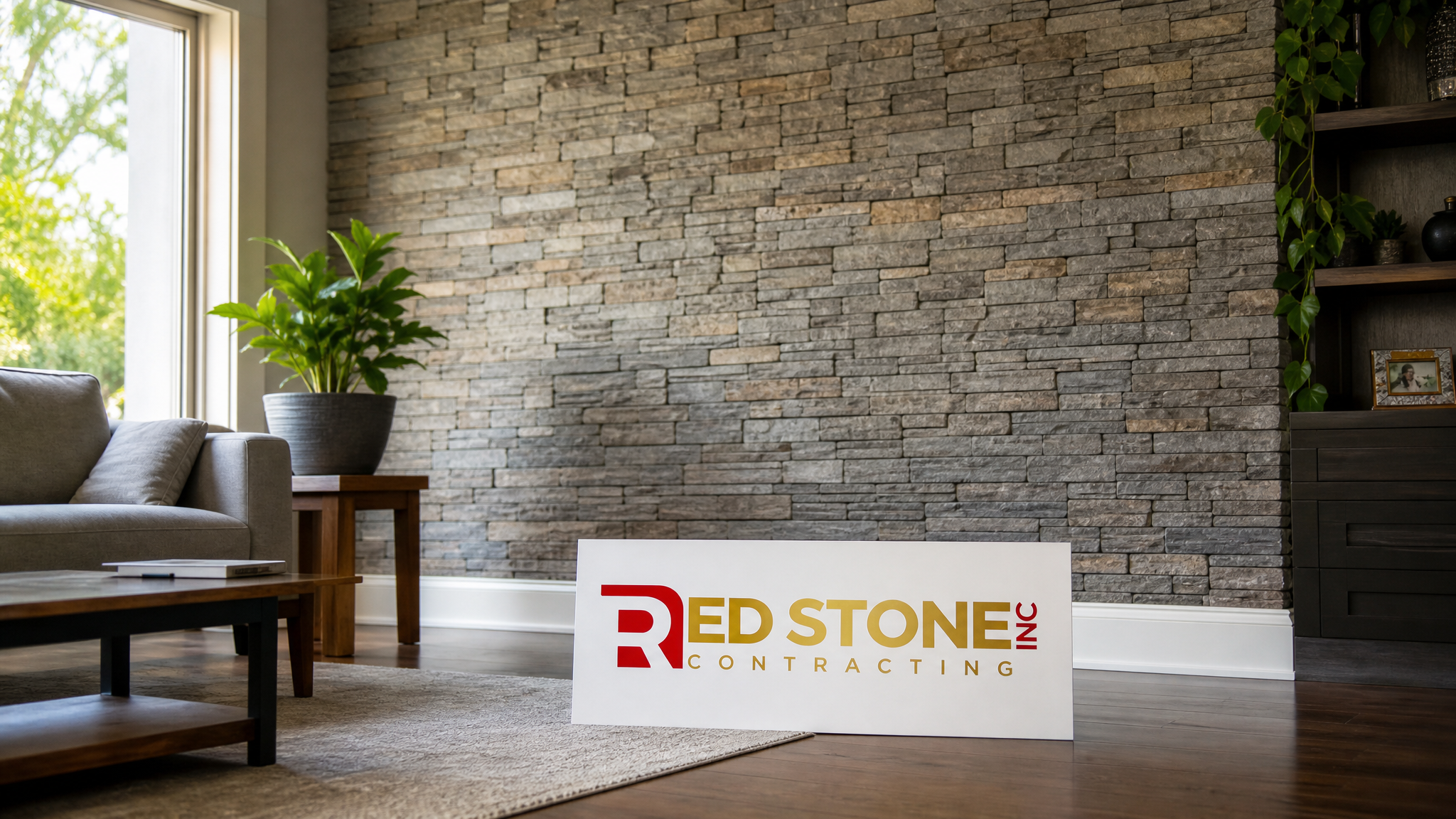
What Is a Stone Veneer Feature Wall Toronto Projects Typically Include?
A stone veneer feature wall is a single accent wall — or occasionally two walls — clad in thin stone panels or individual stone pieces applied over an existing substrate. Unlike full stone masonry, which requires a structural foundation and substantial load-bearing capacity, stone veneer is engineered to be lightweight. Individual panels typically measure between 12 and 50 mm in thickness and weigh far less per square metre than solid stone cladding.
In a stone veneer feature wall Toronto context, the most popular application rooms are:
- Living rooms — framing a fireplace surround or creating a dramatic focal point behind a sofa or media unit
- Basements — transforming a recreation room or home theatre wall into a sophisticated entertainment zone
- Dining rooms — adding an earthy, textural backdrop to a formal or casual dining space
- Entryways and foyers — making a strong first impression from the moment guests walk through the door
- Home offices — providing a professional, design-forward background for video calls and day-to-day work
The material choice between natural stone veneer and manufactured (cultured) stone veneer is the first and most consequential decision you will make. Both have legitimate use cases, distinct cost profiles, and specific advantages depending on your project goals and your home’s construction.
For homeowners planning larger renovation projects alongside a feature wall — such as a full basement renovation or a custom home renovation — bundling trades is often more efficient and cost-effective.
Natural Stone Veneer vs Manufactured Stone Veneer: A Full Comparison
The core debate in any stone veneer feature wall Toronto project comes down to two materials: natural stone veneer (quarried and cut from actual rock) versus manufactured stone veneer (also called cultured stone, made from concrete aggregate moulded and pigmented to replicate natural stone). Each has a distinct profile of strengths, limitations, and appropriate use cases.
Natural stone veneer is quarried directly — common species used in Toronto interiors include slate, quartzite, limestone, marble, granite, and fieldstone. Each piece is unique. The variation in colour, texture, and shape is entirely organic and unrepeatable, which gives natural stone installations a depth and authenticity that manufactured alternatives approach but rarely replicate perfectly. Natural stone is also denser and harder, meaning it resists scratching and chipping better over time in high-traffic areas.
The trade-offs with natural stone are weight and cost. Even as a veneer, natural stone panels are heavier than cultured alternatives, which means substrate requirements are more demanding. You may need additional wall anchoring, particularly for large walls or walls in older Toronto homes with lath-and-plaster construction. Natural stone also costs more per square metre both in materials and in installation labour, because cutting and fitting irregular natural pieces requires more skill and time than snapping together uniformly moulded panels.
Manufactured stone veneer uses Portland cement, aggregate, and iron oxide pigments to produce panels that closely mimic quarried stone at a significantly lower weight. Modern cultured stone products — especially high-quality Canadian-manufactured lines — have advanced considerably. The moulding technology captures surface texture, shadow lines, and colour variation with convincing fidelity. For homeowners working with a tighter budget or who want a more uniform, controllable appearance, manufactured stone veneer is a smart and durable choice.
| Feature | Natural Stone Veneer | Manufactured Stone Veneer |
|---|---|---|
| Material origin | Quarried from bedrock | Concrete aggregate, moulded |
| Weight per sq metre | 40–70 kg | 18–30 kg |
| Material cost (installed) | $85–$180 per sq ft | $40–$95 per sq ft |
| Colour consistency | Highly variable, organic | Controlled, predictable |
| Durability (interior) | Excellent — 50+ years | Very good — 30–50 years |
| Substrate requirements | Reinforced or anchored substrate | Standard cement board or drywall |
| Design variety | Limited to quarried species | Hundreds of styles and colours |
| Eco-profile | Low processing, high transport | Locally manufactured options available |
Stone Veneer Feature Wall Toronto Cost Breakdown for 2026
One of the most common questions we receive is: what does a stone veneer feature wall Toronto installation actually cost? The answer depends on several variables — the size of the wall, the material chosen, substrate preparation required, the complexity of the design (straight stacked panels versus irregular fieldstone pattern), and whether you are bundling it with other renovation work.
The following cost table represents realistic 2026 pricing across the Toronto metropolitan area, including labour, materials, and standard substrate preparation for a wall in good condition. Walls requiring significant drywall removal, moisture barrier installation, or structural anchoring will incur additional costs.
| Wall Size | Manufactured Stone Veneer (Installed) | Natural Stone Veneer (Installed) | Typical Timeline |
|---|---|---|---|
| Small accent wall (up to 20 sq ft) | $1,800–$3,200 | $3,000–$5,500 | 1–2 days |
| Medium feature wall (20–60 sq ft) | $3,500–$7,500 | $6,000–$14,000 | 2–4 days |
| Large statement wall (60–120 sq ft) | $7,000–$14,000 | $12,000–$24,000 | 4–7 days |
| Full room accent (120+ sq ft) | $13,000–$22,000+ | $22,000–$40,000+ | 7–14 days |
| Fireplace surround addition | $2,500–$6,000 | $5,000–$11,000 | 2–4 days |
These figures assume standard residential conditions in the GTA. Costs in Toronto’s core neighbourhoods (Rosedale, Lawrence Park, Forest Hill) tend to run slightly higher due to parking, access logistics, and material delivery constraints. Suburban locations in Mississauga, Vaughan, or Burlington are often more straightforward to service.
Homeowners who are simultaneously investing in a kitchen renovation or bathroom renovation may find cost efficiencies by combining projects — shared mobilisation, overlapping trades, and single-project waste management all contribute to savings when multiple rooms are renovated at once.
Substrate Preparation: The Foundation of a Lasting Installation
The single most important technical aspect of a stone veneer feature wall Toronto project is substrate preparation. No matter how good the stone material is, a poorly prepared substrate will lead to adhesion failures, cracking, and costly remediation within a few years. In summer 2026, with GTA humidity levels moderate and temperatures ideal for adhesive curing, this is an excellent time to execute the prep work correctly.
For manufactured stone veneer applied to existing interior drywall, the standard approach involves:
- Inspecting and repairing any damaged drywall sections
- Applying a moisture barrier membrane where required (particularly in basements or on exterior-adjacent walls)
- Installing cement board or metal lath over the existing surface if the manufacturer’s specifications require it
- Applying a scratch coat of Type S mortar over lath-based substrates to create a mechanical bonding surface
- Allowing full cure time before beginning stone installation — typically 24–48 hours in summer conditions
For natural stone veneer, which is heavier, additional structural considerations apply. Walls in older Toronto homes — particularly semi-detached and detached properties in Etobicoke, East York, Scarborough, and North York built before 1980 — may have plaster-over-lath construction that requires assessment before adding significant weight. In some cases, installing blocking between wall studs is necessary to distribute load safely.
Summer is the ideal season for this work. The warm, dry conditions accelerate mortar scratch coat curing, reduce the risk of moisture migration during substrate preparation, and allow adhesive-set manufactured stone panels to bond reliably without the temperature-drop risks that complicate autumn and early spring installations.
Design Styles and Pattern Options for Stone Veneer Feature Walls
One of the most enjoyable parts of planning a stone veneer feature wall Toronto project is the sheer range of design directions available. The combination of material species, finish, colour palette, and laying pattern gives homeowners tremendous flexibility to customise the look to their existing interior and personal aesthetic.
The most popular styles we install in GTA homes in 2026 include:
Stacked Ledger Panels: Clean horizontal lines of flat-cut stone, stacked in a consistent course. This is the most contemporary option and works exceptionally well in modern and transitional interiors. The linear geometry pairs naturally with floating shelves, recessed linear fireplaces, and minimalist furniture. Slate, quartzite, and certain manufactured panel lines excel in this format.
Irregular Fieldstone / Mosaic: Pieces of varying size, shape, and depth arranged in an organic, natural-looking pattern. This style evokes a rustic or heritage aesthetic and is popular in Toronto homes with exposed brick elsewhere, or in cottage-style country properties throughout the Halton and Peel regions. Mortar joints are a visible feature in this style, and their colour and width are important design choices.
Dry-Stack (Mortar-Free Look): Tightly fitted panels that eliminate visible mortar joints entirely, creating the impression of stone laid without binding material. This technique requires precise cutting and tight tolerances, but the result is a seamless, high-end appearance that photographs exceptionally well. Many manufactured panel systems are specifically engineered for dry-stack installation.
Split-Face: Stone is cut so that the face is deliberately rough and uneven, with deep texture variation. The visual effect is dramatic and tactile. Split-face is popular for fireplace surrounds and full-height living room feature walls in Toronto’s luxury home renovations.
Herringbone and Chevron: Less common but growing in popularity, these diagonal laying patterns introduce movement and dynamism to a feature wall. They require precise cutting and are best executed by experienced stone installers.
Colour selection is equally important. In summer 2026, warm earth tones — taupe, sand, terracotta, and ochre — are popular because they complement the natural light that floods GTA homes during the long summer days. Cooler grey and charcoal palettes work well in north-facing rooms where light is softer and more consistent. Our design solutions team can provide colour consultations to ensure your stone veneer choice harmonises with your flooring, cabinetry, and existing finishes.
The Installation Process: Step by Step
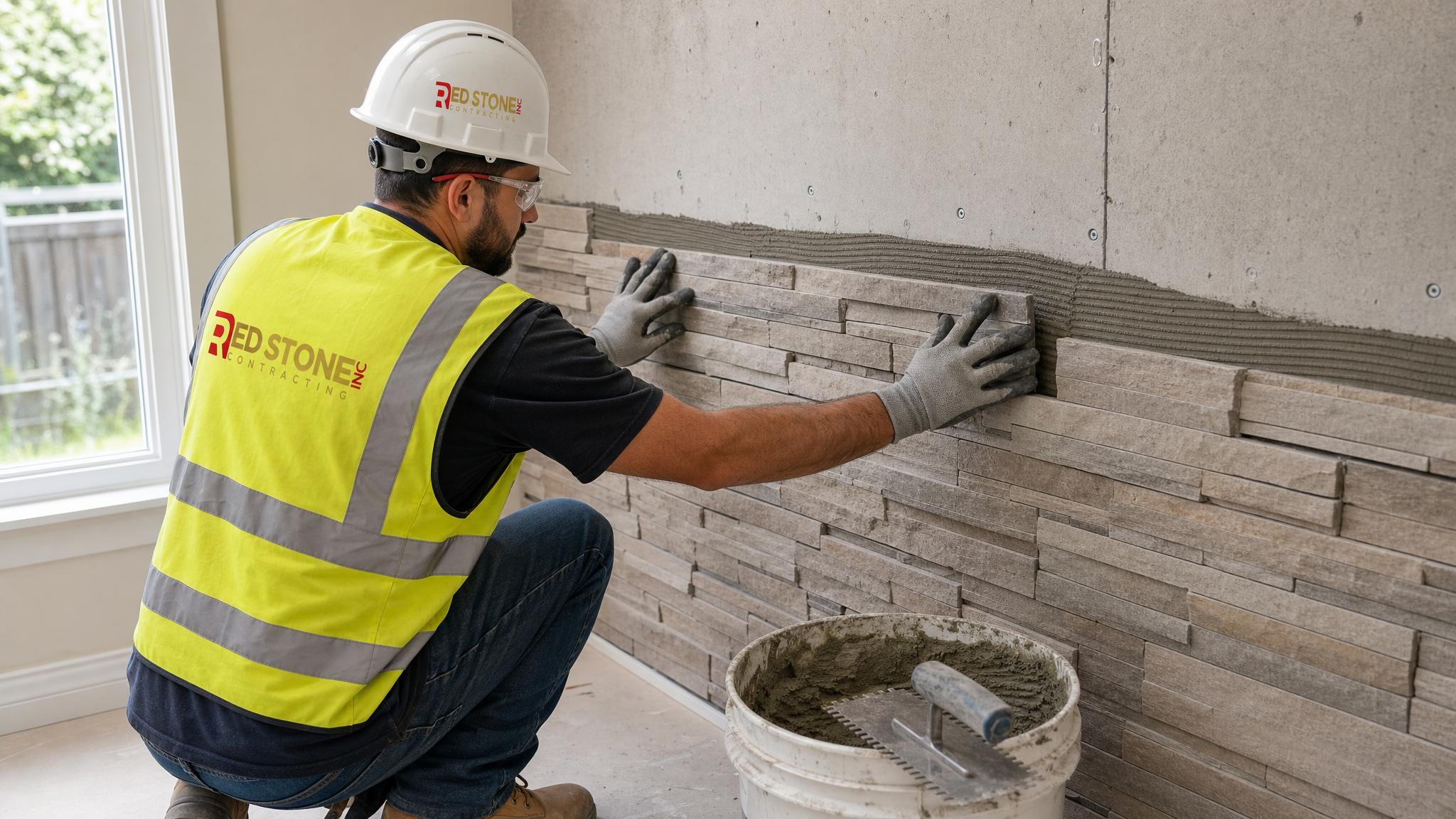
Understanding the installation sequence helps homeowners plan around the work and set realistic expectations. A typical stone veneer feature wall Toronto installation by a professional crew follows this sequence:
Day 1 — Assessment and Prep: The crew inspects the substrate, removes any baseboards or trim in the work zone, and installs cement board or lath if required. A moisture barrier is applied where specified. The scratch coat (if applicable) is applied and allowed to set.
Day 2 — Layout and First Courses: The installer establishes level reference lines across the wall, plans the stone layout to avoid thin slivers at edges, and begins applying the first course from the bottom up. Corner pieces (for walls wrapping around corners) are typically installed first to establish clean edge lines.
Days 2–4 — Main Field Installation: Stone panels or individual pieces are applied progressively up the wall. Each row is checked for level, plumb, and consistent joint spacing. Pieces requiring cuts are trimmed with a wet saw. Adhesive or mortar is applied to the back of each piece and pressed firmly into place.
Final Day — Grouting, Sealing, and Trim Reinstallation: For installations requiring mortar joints, grout is tooled into the joints after the adhesive has cured. Once the grout is set, a penetrating stone sealer is applied (particularly important for natural stone). Trim and baseboards are reinstalled and caulked at the stone transition.
Summer conditions in Toronto are nearly ideal for this entire sequence. Adhesives and mortars cure faster and more completely at temperatures between 18°C and 28°C — the typical June range in the GTA. The longer daylight hours also give crews more usable working time per day, reducing project timelines compared to autumn or spring installations.
Maintenance, Durability, and Long-Term Care
A well-installed stone veneer feature wall Toronto is one of the lowest-maintenance interior upgrades you can make. Neither natural nor manufactured stone veneer requires regular refinishing, repainting, or structural upkeep the way wood panelling or wallpaper does. That said, a few maintenance practices will extend the life and appearance of your installation significantly.
Sealing: Natural stone veneer should be sealed at installation and resealed every 3–5 years with a penetrating stone sealer appropriate for the stone species. Slate and limestone are particularly porous and benefit most from consistent sealing. Manufactured stone veneer products are generally less porous but benefit from a silicone-based water repellent applied every 5 years to prevent any efflorescence (white mineral deposits) from forming.
Cleaning: Routine cleaning is as simple as a dry microfibre cloth or a lightly damp cloth for dust and smudges. For deeper cleaning, use a pH-neutral stone cleaner — never vinegar, bleach, or acidic general-purpose cleaners, which can etch and discolour both natural and manufactured stone surfaces.
UV and Heat Considerations: In summer, direct southern sun exposure through large windows can cause some stone pigments — particularly in lower-quality manufactured products — to fade over time. If your feature wall receives significant direct sun, consider UV-filtering window film or discuss UV-stable product lines with your installer. Natural stone is inherently UV-stable, as its colour comes from mineral composition rather than applied pigment.
Grout Joint Maintenance: Over years and decades, mortar or grout joints may develop hairline cracks, particularly at wall corners or where the stone wall meets a different material. Tuck-pointing (applying fresh mortar into deteriorated joints) is a straightforward repair that can be done in a few hours without disturbing the stone field.
Frequently Asked Questions About Stone Veneer Feature Walls in Toronto
What does a stone veneer feature wall Toronto installation typically cost in 2026?
How long does it take to install a stone veneer feature wall in Toronto?
Is natural stone or manufactured stone veneer better for a feature wall?
Can stone veneer be installed over existing drywall?
Does a stone veneer feature wall add resale value to a Toronto home?
Is summer a good time to install a stone veneer feature wall in Toronto?
Planning Your Stone Veneer Project: Key Questions to Ask Your Contractor
Before committing to a stone veneer feature wall Toronto project, asking the right questions during the contractor consultation stage will save you from budget surprises, timeline overruns, and material disappointments. Here is a practical checklist:
- What substrate preparation does this installation require? Will you need cement board, lath, or a moisture barrier? Are those costs included in the quote?
- Is this material appropriate for my specific wall? Especially important if you have an older home with plaster walls, or if the feature wall is on an exterior-facing surface.
- What grout or mortar joint colour do you recommend? Joint colour dramatically affects the final look — lighter joints make stone appear brighter and more uniform; darker joints add depth and let the stone itself dominate.
- What sealer will be applied, and how often will I need to reseal? Maintenance requirements vary significantly between stone species.
- How will cuts at wall edges and corners be handled? Ask to see examples of the installer’s corner and edge treatment work.
- Is there an allowance for material waste? Stone cutting always generates waste; standard practice is to order 10–15% more material than the net wall area requires.
Homeowners planning a comprehensive interior overhaul — including a Toronto renovation project spanning multiple rooms — benefit from working with a single contractor who can coordinate all trades and ensure design cohesion across the entire project scope. Our team manages the full workflow, from design consultation through installation and final walkthrough.
It is also worth considering how your stone veneer feature wall integrates with other elements of your renovation. A feature wall in a basement entertainment room, for example, often pairs best with basement renovation work that encompasses flooring, lighting, and built-in millwork at the same time, rather than as an isolated single-surface upgrade.
| Stone Species / Product | Interior Suitability | Maintenance Level | Approx. Material Cost (per sq ft) | Best Design Style Match |
|---|---|---|---|---|
| Slate (natural) | Excellent | Low — seal every 4–5 years | $18–$35 | Contemporary, transitional |
| Limestone (natural) | Excellent | Moderate — seal every 2–3 years | $20–$45 | Traditional, heritage |
| Quartzite (natural) | Excellent | Low — seal every 5 years | $25–$55 | Luxury modern, transitional |
| Fieldstone (natural) | Very good | Low — occasional joint inspection | $15–$30 | Rustic, farmhouse, cottage |
| Cultured/manufactured panel | Excellent | Very low — water repellent every 5 years | $8–$22 | All styles, widest variety |
| Stacked ledger (manufactured) | Excellent | Very low | $10–$25 | Modern, Scandinavian, minimalist |
Schedule Your Stone Veneer Feature Consultation Today
A stone veneer feature wall Toronto installation is one of the highest-impact, longest-lasting interior upgrades a GTA homeowner can make in 2026. Whether you are drawn to the organic authenticity of natural quarried stone or the design flexibility and cost efficiency of modern manufactured panels, Red Stone Contracting brings the expertise, the craftsmanship, and the local knowledge to deliver a finished wall that exceeds your expectations — on time, on budget, and built to last.
Call us today at (905) 901-1006 or request a free consultation to get started.
Red Stone Contracting proudly serves Toronto, Mississauga, Markham, Vaughan, Brampton, and Burlington with full-service renovation expertise across every room of your home.