
Stepping onto a warm tile floor on a January morning in the GTA is one of those small luxuries that quickly feels essential, and that is exactly why so many homeowners now ask about heated floors Toronto cost before starting a bathroom or basement project. In-floor radiant heating has moved from a high-end extra to a mainstream upgrade across Toronto, Mississauga and Burlington, especially in below-grade basements and ceramic-tiled bathrooms where cold floors are a chronic complaint. This guide breaks down realistic 2026 pricing, the difference between electric and hydronic systems, installation timelines, Ontario electrical code considerations, and a clear-eyed look at whether the investment actually pays off for your home.
We will keep the numbers grounded in what GTA contractors are actually charging in 2026, not glossy national averages. Whether you are reworking a single ensuite or finishing an entire basement, understanding the cost structure up front helps you budget accurately and avoid the surprise change orders that derail renovation projects.
What Drives Heated Floors Toronto Cost in 2026
The biggest factor in heated floors Toronto cost is the type of system you choose. Electric radiant systems use thin heating cables or pre-spaced mats embedded in thinset under tile, and they are the dominant choice for bathrooms and smaller rooms. Hydronic systems circulate warm water through PEX tubing connected to a boiler or water heater, and they make more financial sense for large floor areas like full basements or whole-home installs. The second factor is floor area in square feet, followed by floor build-up requirements, the finished flooring material, and electrical or plumbing work needed to feed the system.
In Toronto and Mississauga, labour rates and the cost of pulling a new dedicated circuit to a sub-panel both push prices above what you might see quoted in smaller Ontario towns. Older homes in neighbourhoods like the Annex, Leaside or central Burlington often need panel upgrades to support electric heat, which is a hidden cost many homeowners overlook. A proper assessment from a renovation team like Red Stone Contracting catches these issues before they become budget surprises.
| System Type | Best For | Installed Cost (per sq ft, 2026 GTA) | Heat Source |
|---|---|---|---|
| Electric cable/mat | Bathrooms, small rooms, retrofits | $22 – $40 | 240V dedicated circuit |
| Hydronic (water) | Basements, large areas, new builds | $18 – $32 | Boiler or combi water heater |
| Electric in self-levelling slab | Basements over concrete | $26 – $45 | 240V circuit + thermostat |
| Low-voltage mesh systems | Engineered wood, laminate | $24 – $38 | Transformer + circuit |
These per-square-foot figures include materials, the heating element, a programmable thermostat, sensor, and professional labour, but they exclude the finished flooring itself and any electrical panel upgrades. For a full bathroom renovation the heated floor is typically a line item folded into the broader tile and waterproofing scope.
Electric vs Hydronic: Which System Fits Your GTA Home
For a typical Toronto bathroom of 40 to 80 square feet, electric radiant is almost always the right call. The upfront cost is low, the floor build-up is minimal at roughly 3 to 6 millimetres of added height, and you can run it on a dedicated 240-volt circuit. Operating costs are modest because you only heat the room when needed, and most homeowners run bathroom floors on a schedule keyed to morning and evening use.
Hydronic systems shine when the heated area grows. Across a 700-square-foot basement, the per-square-foot operating cost of water-based heat is far lower than electric, and the system can double as the primary heat source for the space rather than just floor warming. The trade-off is a higher installation cost, a thicker floor assembly, and the need for a boiler or a combi unit with capacity to spare. In a basement renovation, the choice often comes down to whether you are heating one zone or the whole level.
| Factor | Electric Radiant | Hydronic Radiant |
|---|---|---|
| Upfront install cost | Lower | Higher (boiler/manifold) |
| Operating cost (small area) | Low | Moderate |
| Operating cost (large area) | High | Low |
| Floor height added | 3 – 6 mm | 30 – 50 mm |
| Best application | Bathrooms, retrofits | Basements, whole-floor, new build |
| Lifespan | 20+ years (element) | 25 – 40 years (tubing) |
One practical note for GTA retrofits: electric systems rarely require structural changes, while hydronic floors in a finished basement may need the slab built up or the ceiling height sacrificed. If your basement already has marginal headroom, that 30 to 50 millimetres matters, and it is worth discussing during the design phase rather than after demolition.
Real Project Cost Examples Across Toronto, Mississauga and Burlington
Abstract per-square-foot rates only get you so far, so here are realistic 2026 project budgets for common scenarios. These reflect mid-range finishes and assume the heated floor is part of a larger renovation, which is the most cost-efficient way to install it because the floor is already open.
| Project Scenario | Approx. Area | System | Heated Floor Cost (2026) |
|---|---|---|---|
| Powder room / small ensuite | 35 sq ft | Electric mat | $900 – $1,500 |
| Main family bathroom | 75 sq ft | Electric cable | $1,800 – $3,000 |
| Primary spa ensuite | 120 sq ft | Electric cable | $3,000 – $4,800 |
| Finished basement floor | 650 sq ft | Hydronic | $13,000 – $22,000 |
| Basement zone (rec area) | 300 sq ft | Electric in slab | $8,000 – $13,500 |
Add roughly $400 to $900 for a new dedicated circuit and breaker, and $1,500 to $3,500 if your electrical panel needs upgrading to accommodate the load, which is common in older Toronto homes. Hydronic basement projects that require a new boiler can add $5,000 to $9,000, so for a single basement the math often favours electric in-slab heat unless you plan to extend hydronic heating elsewhere in the home.
Installation Timeline and the Ontario Code Details That Matter
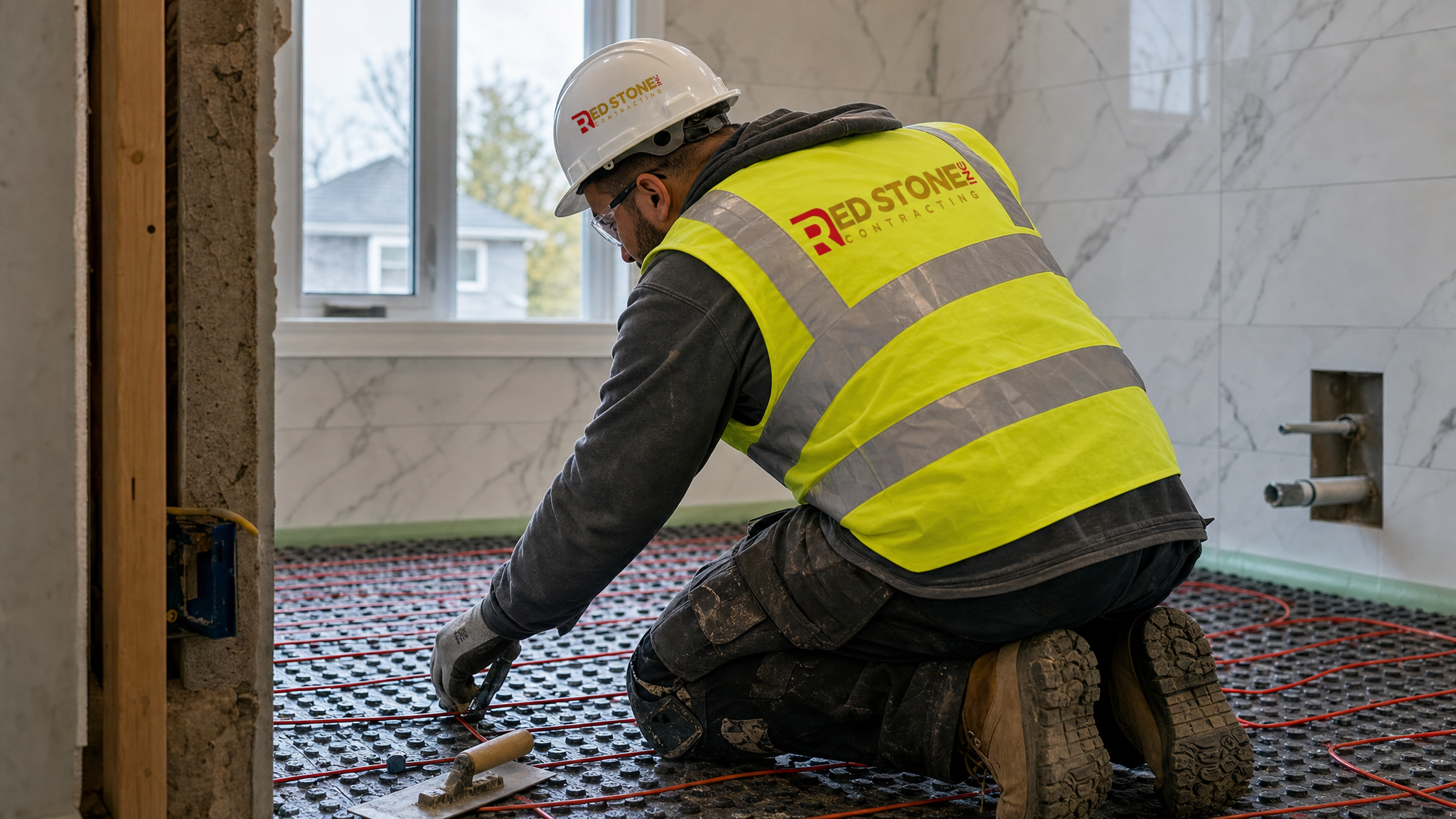
Homeowners are often surprised that the heated element itself is one of the faster parts of the job. The real time is in floor preparation, waterproofing, the mandatory thinset cure, electrical connection, and tile work. Below is a realistic sequence for an electric bathroom floor installed as part of a renovation.
| Stage | Work Involved | Typical Duration |
|---|---|---|
| Demolition & subfloor prep | Remove old floor, level, check deflection | 1 – 2 days |
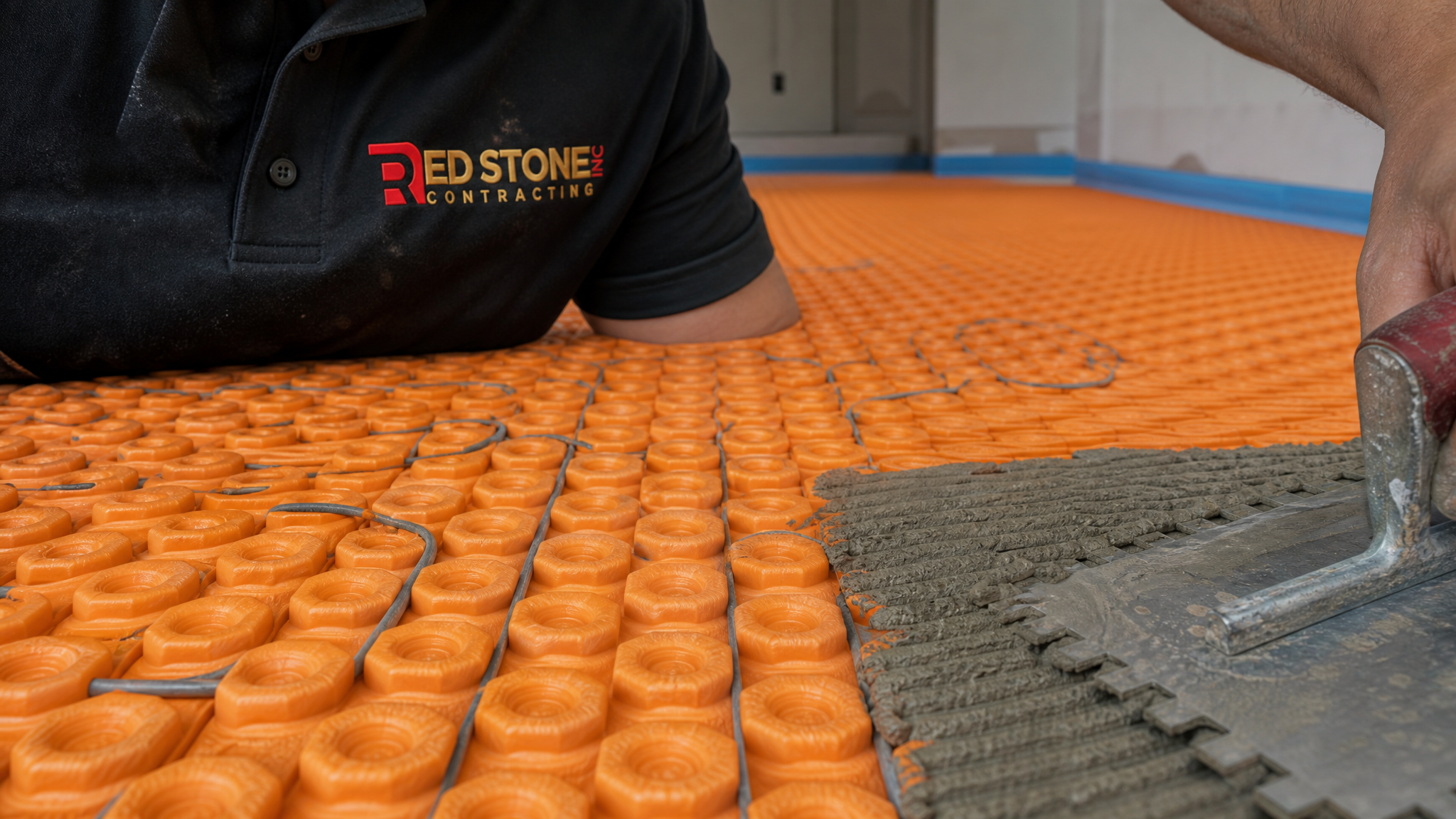
| Membrane & cable layout | Uncoupling membrane, set cable spacing, sensor | 1 day |
| Electrical rough-in | Dedicated circuit, thermostat box, GFCI | 0.5 – 1 day |
| Thinset & tile | Embed element, set tile, cure | 2 – 3 days |
| Grout, connection & testing | Grout, connect thermostat, verify resistance | 1 – 2 days |
On the code side, the Ontario Electrical Safety Code requires that floor-heating circuits in wet areas be protected by GFCI, and the thermostat must use a floor sensor rather than relying on air temperature alone. Electric floor heating in bathrooms must be on a dedicated circuit, and the installation must be done or inspected so that it complies with ESA requirements. A qualified contractor will measure the heating element’s resistance before, during, and after tiling to confirm no cable was damaged, because a fault discovered after the tile is set is an expensive repair.
Permits are another consideration. In Toronto, Mississauga and Burlington, the electrical portion is governed by the Electrical Safety Authority, and broader renovation work may require municipal building permits depending on scope. Folding heated floors into a permitted Toronto renovation keeps everything documented and inspected, which protects resale value and insurance coverage.
Operating Costs and Energy Use in the GTA Climate
A frequent worry is the hydro bill. For electric radiant in a bathroom, the actual operating cost is lower than most people expect because the heated area is small and the system runs on a schedule. A typical 75-square-foot bathroom floor draws roughly 10 to 12 watts per square foot, so about 900 watts total, and running it a few hours per day during the heating season adds only a modest amount to a GTA hydro bill, particularly when scheduled around Ontario’s time-of-use pricing to avoid peak rates.
| Space | System Draw | Daily Use | Est. Monthly Operating Cost (winter) |
|---|---|---|---|
| Small bathroom (40 sq ft) | ~480 W | 3 hrs | $4 – $8 |
| Main bathroom (75 sq ft) | ~900 W | 4 hrs | $9 – $16 |
| Basement zone (300 sq ft, electric) | ~3,600 W | 5 hrs | $45 – $75 |
| Full basement (650 sq ft, hydronic) | Boiler-fed | Continuous low | $30 – $60 |
The takeaway is that small electric bathroom floors are cheap to run, while large electric basement areas can get expensive, which again steers bigger projects toward hydronic. Pairing heated floors with proper basement insulation and an uncoupling membrane that limits heat loss into the slab improves efficiency significantly, something we factor into every Mississauga renovation that includes radiant heat.
Is In-Floor Heating Worth It? Value, Comfort and Resale
Worth-it is partly financial and partly about how you live in your home. On pure energy savings, radiant floor heating will not pay for itself quickly, because it is a comfort upgrade more than an efficiency play. The genuine value shows up in three areas: daily comfort, the elimination of cold concrete basement floors, and marketability at resale. In the GTA market, finished basements and renovated bathrooms with heated floors photograph and show extremely well, and buyers consistently rate them as a desirable feature.
| Value Factor | Heated Floor Impact | Notes |
|---|---|---|
| Daily comfort | High | Biggest payoff; warm tile every morning |
| Energy savings | Low to moderate | Comfort upgrade, not a payback play |
| Resale appeal | Moderate to high | Strong in renovated baths and basements |
| Basement usability | High | Removes cold-slab discomfort year-round |
| Maintenance | Very low | No moving parts in electric systems |
For most GTA homeowners, the verdict is that heated floors are absolutely worth it when added during an existing renovation, where the incremental cost is small relative to the comfort gain, and harder to justify as a stand-alone tear-up of an otherwise good floor. The single most cost-effective time to install is when the floor is already open for a custom home renovation, an addition, or a gut bathroom project. If you are weighing the decision for a Burlington home, our team can walk the space and give you exact numbers as part of Burlington renovation services rather than a generic estimate.
How to Get Heated Floors Toronto Cost Right and Avoid Overpaying
To keep your heated floors Toronto cost predictable, insist on a quote that itemizes the heating element, the thermostat and sensor, the electrical work, and the floor finish separately. Confirm whether a panel upgrade is included or excluded, since that single item can swing a budget by thousands. Ask how the contractor verifies the cable resistance during installation, and confirm the system carries a manufacturer warranty, which on quality electric elements typically runs 20 to 25 years.
Beware quotes that look unusually low; they often omit the uncoupling membrane, GFCI protection, or proper waterproofing, all of which are essential in a wet area and code-required in Ontario. A reputable GTA renovator will also coordinate the heated floor with the rest of the trades so the tile, plumbing, and electrical sequence correctly. When heated floors are part of a larger scope like a kitchen renovation or a basement build-out, that coordination is where a full-service contractor earns its keep and protects you from costly rework.
What is the average heated floors Toronto cost for a bathroom in 2026?
Is electric or hydronic radiant heating better for a Toronto basement?
How much does it cost to run heated floors in the GTA?
Does heated flooring add value when selling a Toronto home?
What Ontario code rules apply to heated bathroom floors?
Can I get an accurate quote for my specific home?
Get Your Heated Floors Toronto Cost Estimate and Start Warming Up
Heated floors turn a cold tile bathroom or a chilly basement slab into one of the most comfortable spaces in your home, and the smartest time to add them is during a renovation when the floor is already open. Red Stone Contracting designs and installs electric and hydronic radiant systems across the GTA, coordinating the tile, waterproofing, and electrical work so the result is code-compliant, efficient, and built to last decades.
Call us today at (905) 901-1006 or request a free consultation to get an itemized estimate tailored to your bathroom or basement project.
Red Stone Contracting has been serving Toronto, Mississauga, Burlington and the GTA with expert home renovations, delivering quality craftsmanship and transparent pricing on every project.