
If you are planning to renovate an older home and someone has mentioned vermiculite in the attic, stop and plan before any ceiling, wall or attic work begins. Vermiculite is a lightweight, pebble-like insulation that was poured into many Canadian attics and wall cavities decades ago, and some of it contains asbestos. Health Canada’s advice is straightforward: if you have it, assume it may contain asbestos and do not disturb it. This article explains how to recognize it, what testing can and cannot tell you, how qualified abatement works in Ontario and how it reshapes a renovation schedule.
We are writing this as renovators, not as an abatement company. Our role on these projects is to spot the issue early, stop work that would disturb it, bring in qualified asbestos professionals and then rebuild once the space is cleared. Nothing here is a guide to removing it yourself, and we strongly advise against trying.
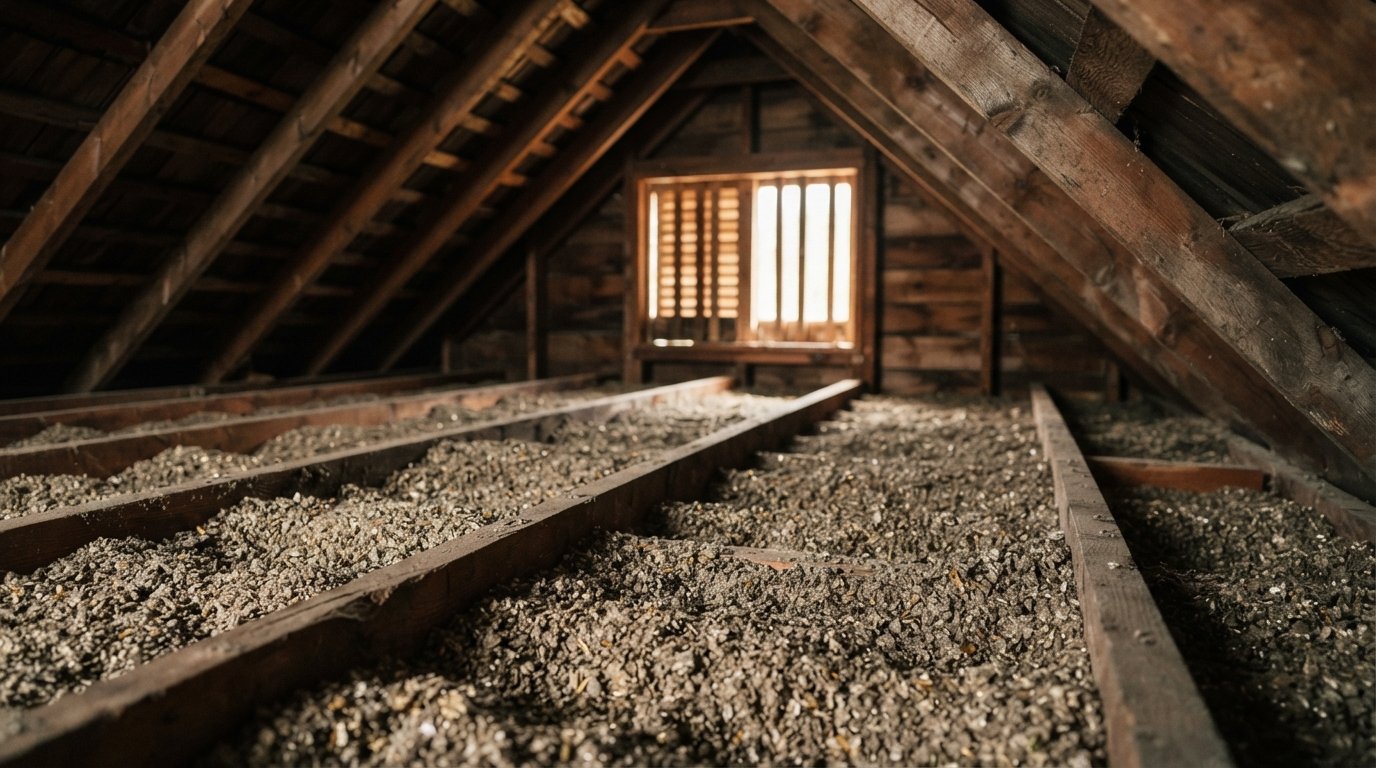
What Vermiculite Is And How To Recognise It
Vermiculite is a naturally occurring mineral that expands when heated into light, accordion-shaped granules. It was sold as loose-fill insulation and poured between attic joists or down into wall cavities. It is fire resistant and easy to install, which is why it was popular in houses built or upgraded from roughly the 1940s through the 1980s.
The concern is not vermiculite as a mineral in general. Much of the loose-fill product sold in North America came from a mine in Libby, Montana, where the ore was contaminated with asbestos. A large share was sold under the brand name Zonolite. Health Canada notes that insulation from that source may contain asbestos, and because you usually cannot tell the origin by looking at it, the safe assumption is that any such insulation in your home may contain asbestos.
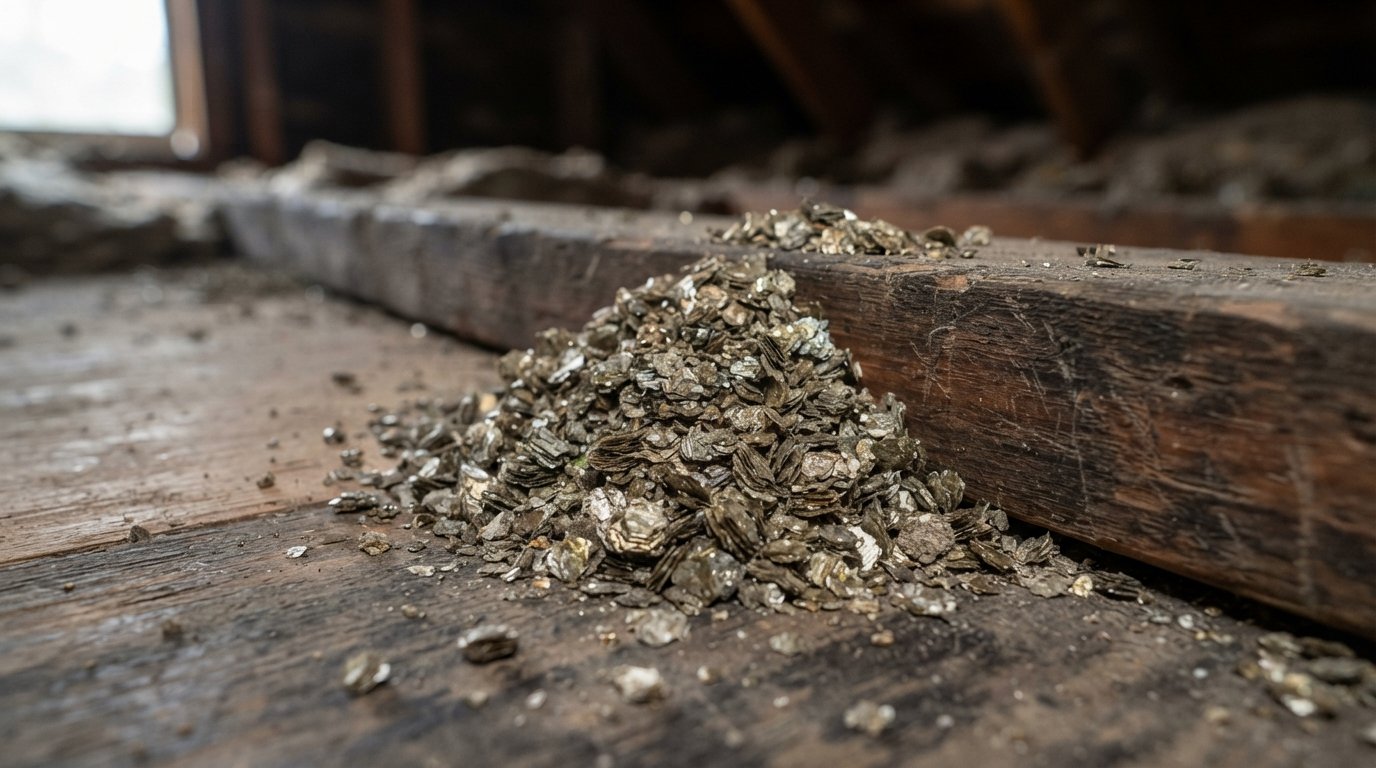
What it usually looks like
- Colour: grey-brown, silvery or golden, sometimes with a slight shimmer when light hits it.
- Texture: small, lightweight, pebble-like pieces, often a few millimetres across, with a layered or accordion appearance.
- Location: loose between attic joists, sometimes under a later layer of fibreglass batts or blown-in cellulose, and sometimes inside exterior wall cavities.
- Clues around the house: small granules trickling out of ceiling light fixtures, around attic hatches, or from gaps where interior walls meet the ceiling.
Do not dig through insulation to find out what is underneath. If you can see a few granules at the hatch opening or at a fixture without disturbing anything, that is enough to treat the attic as a potential asbestos location until a professional says otherwise.
| Insulation type | Typical appearance | How it compares |
|---|---|---|
| Vermiculite | Grey-brown or gold granules, pebble-like, lightweight | Treat as potentially containing asbestos |
| Loose fibreglass | Fluffy, white, pink or yellow fibres | Fibrous and cotton-like rather than granular |
| Cellulose | Grey, shredded paper appearance, dusty | Fibrous and flat, not shiny or layered |
| Rock or mineral wool | Grey, green or brown wool-like fibres | Wool texture, no pebble-shaped pieces |
| Perlite | White, round, very light granules | Granular but usually white and smooth; still worth confirming by lab |
If your plans involve older plaster, trim or structure, our restorations team for older homes is used to working through this kind of discovery before rebuilding begins.
Why Health Canada Says Not To Disturb It
Asbestos is a health risk when its fibres become airborne and are breathed in. Long-term exposure is linked to serious diseases, including lung cancer, mesothelioma and asbestosis, which may not appear until many years later. Undisturbed insulation sealed in an attic is not releasing much into the living space. The risk rises sharply when someone moves it: sweeping, vacuuming, walking through it, pulling down a ceiling or cutting a hole for a pot light.
Health Canada’s general guidance for homeowners who have this type of insulation includes these points (check the current Health Canada page for the latest wording):
- Do not disturb it. Leave it in place if it is sealed off and you are not renovating the area.
- Do not store belongings in an attic that contains it, and keep people out of that space.
- Seal cracks and openings in ceilings and walls, such as gaps around light fixtures and the attic hatch, so granules and dust cannot move into living areas.
- Do not use a regular household vacuum to clean up granules; household vacuums can spread fine fibres.
- If you plan renovations that would disturb it, hire a qualified asbestos removal professional.
That last point is the one that matters most in a renovation. Attic insulation upgrades, new pot lights, bathroom exhaust fans, ceiling removal, second-storey additions, rewiring and roof work that opens the deck can all disturb it.
Renovation Work That Can Disturb Vermiculite
Homeowners often focus only on the attic, but the insulation can travel. It settles into wall cavities, drops through gaps in top plates and collects above ceiling fixtures. Before any of the following work starts in an older house, ask whether granular attic insulation could be present:
| Planned work | How it could disturb the insulation | What to do first |
|---|---|---|
| Adding attic insulation | Installers walk through and blow material over it | Assessment and abatement before any insulation work |
| Pot lights or ceiling fans on the top floor | Cutting holes lets granules fall into rooms | Confirm what is above the ceiling before cutting |
| Removing top-floor ceilings or walls | Demolition drops insulation from above and within cavities | Assessment of attic and wall cavities; abatement plan |
| Second-storey addition or roof replacement with deck work | Opening the roof structure exposes the attic | Abatement scheduled before framing or roofing |
| Rewiring or running new ducts | Fishing wires and ducts through attics and walls | Plan routes after assessment; avoid disturbed zones |
| Exterior wall openings for windows or doors | Cutting into cavities that may hold poured insulation | Check wall cavities during the pre-renovation survey |
If you are planning a larger project such as a home addition on an older house, building the assessment into the design phase avoids the costly surprise of discovering it after the roof is open.
Testing Vermiculite: What A Lab Result Can And Cannot Tell You
Testing is done by collecting samples and sending them to a laboratory accredited for asbestos analysis. The sampling itself disturbs the material, so it should be done by a qualified asbestos consultant or abatement professional using proper protection and containment, not by the homeowner.
There is an important limitation. Asbestos in vermiculite is often unevenly distributed, and a sample may come back with no asbestos detected even though other parts of the same attic contain it. Because of that, many professionals and public health agencies advise treating vermiculite as asbestos-containing regardless of a single negative result, especially when the work will disturb a large amount of it. A positive result settles the question; a negative result should be discussed with your consultant before you rely on it.
What a proper assessment includes
- A walk-through by a qualified asbestos consultant to identify where suspect insulation and other materials are located.
- Sampling where appropriate, with the chain of custody documented and samples sent to an accredited lab.
- A written report describing materials found, their condition and their extent.
- Recommendations on whether abatement is needed for the planned work, and at what scope.
- For renovation projects, a copy of the report that you can share with contractors so their workers know what is present.
In older homes, it is worth asking the consultant to look at other common asbestos-containing materials at the same visit: some older plaster, textured ceilings, vinyl floor tiles and their adhesives, pipe and duct wrap, and some older drywall joint compounds. Discovering them in one survey is far easier than finding them one at a time.
Qualified Abatement And Ontario Regulation 278/05
In Ontario, asbestos work on construction projects is governed by Ontario Regulation 278/05, the regulation on asbestos on construction projects and in buildings and repair operations, made under the Occupational Health and Safety Act. At a general level, it classifies asbestos work into Type 1, Type 2 and Type 3 operations based on risk, and sets out the precautions, training, equipment and procedures required for each. Removing or disturbing larger amounts of friable material, which loose-fill insulation is, is generally treated as higher-risk work with strict controls. Your abatement contractor should explain which classification applies to your job and why.
The regulation is aimed at workers and employers, which means that once you hire a contractor to do work that will disturb asbestos, that contractor has legal obligations to protect workers and follow prescribed procedures. For homeowners, the practical takeaway is simple: hire an abatement company with trained workers, proper equipment and experience with loose-fill insulation, and make sure your renovation contractor does not start work in affected areas until abatement is complete. Confirm current requirements with the Ontario Ministry of Labour, Immigration, Training and Skills Development or your abatement contractor, as rules and guidance can change.
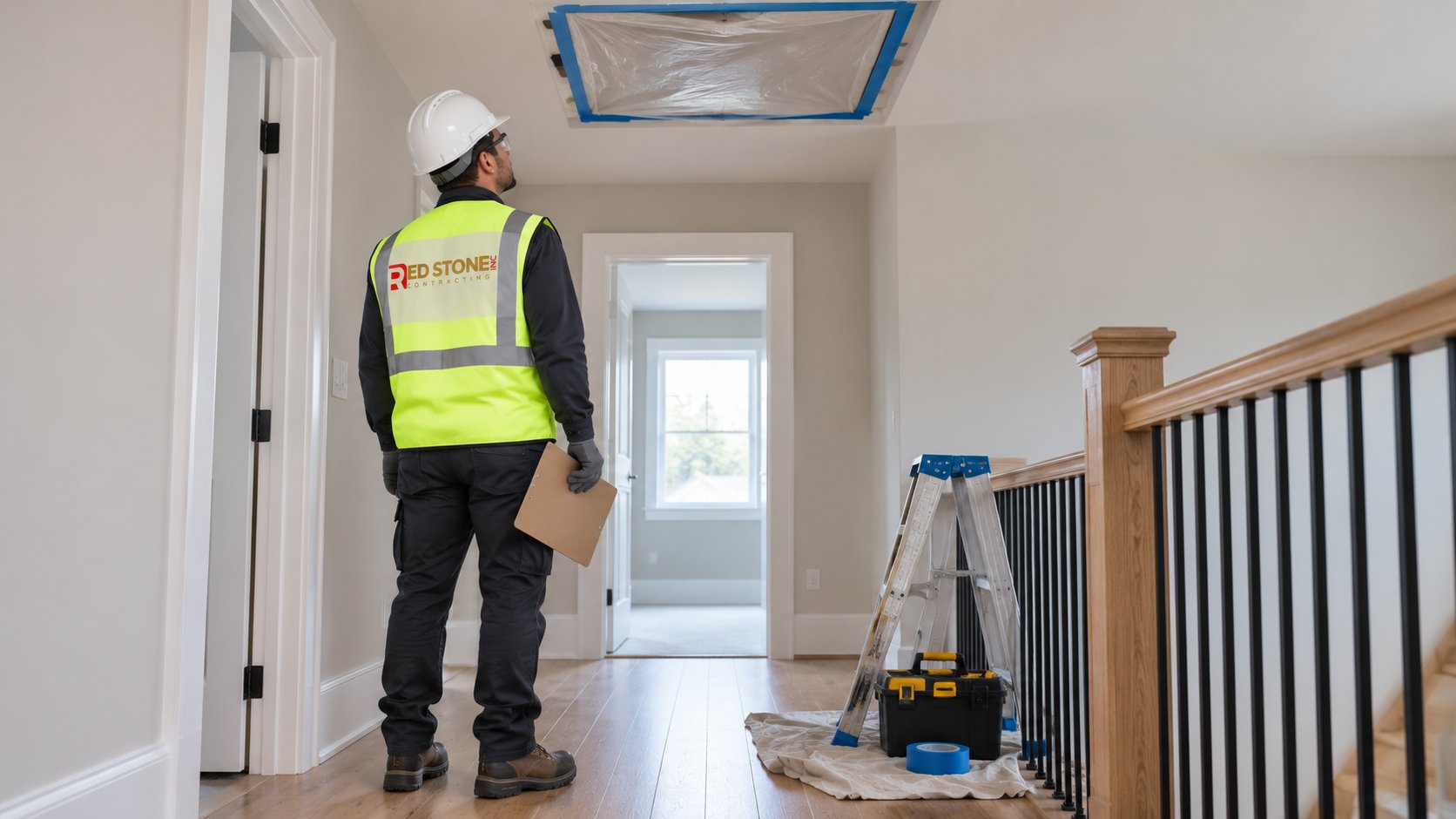
What professional vermiculite removal typically involves
Every abatement company works to its own procedures within the regulation, but homeowners can usually expect:
- Containment: the attic and work area are sealed from the rest of the house, often with polyethylene sheeting and sealed access points.
- Negative air pressure: filtered air machines keep air flowing into the work area rather than out into living spaces.
- Decontamination facilities: workers enter and exit through a decontamination area so they do not carry fibres into the house.
- Removal method: loose-fill is typically removed with specialized high-capacity HEPA-filtered vacuum equipment, with bags or hoses run to a sealed collection point.
- Packaging and disposal: waste is sealed, labelled and taken to a site that accepts asbestos waste, following provincial rules.
- Cleaning and clearance: surfaces are cleaned, and air testing is often done before the containment comes down.
This insulation has a habit of hiding in awkward places: behind top plates, under attic floorboards, inside wall cavities and around chimneys. A thorough job accounts for these areas. Ask your abatement contractor how they handle material that has fallen into wall cavities, and what they do if they find more than expected once work starts.
How Abatement Changes Your Renovation Schedule
Discovering vermiculite does not have to derail a renovation, but it does change the order of work. The key rule is that abatement happens before anything else in the affected areas, and the renovation crew only returns once the space has been cleared.
A typical sequence looks like this:
- Discovery and stop work: if suspect insulation is identified during planning or found during work, activity in that area stops and openings are sealed.
- Assessment: an asbestos consultant surveys the house and, where appropriate, samples go to an accredited lab. Allow time for scheduling the visit and receiving results.
- Abatement quotes and scheduling: you obtain quotes from qualified abatement companies. Their availability can add weeks, especially in busy seasons.
- Abatement: the attic or affected cavities are contained and cleared. Small attics may take a few days; larger or complicated jobs take longer.
- Clearance: cleaning and any air testing are completed before containment is removed.
- Renovation resumes: air sealing, new insulation, electrical and the planned renovation work proceed as designed.
| Stage | Who is responsible | What the homeowner should expect |
|---|---|---|
| Suspect material identified | Renovation contractor or homeowner | Work in the area stops and openings are sealed |
| Assessment and sampling | Qualified asbestos consultant | A site visit, then a wait for accredited lab results and a written report |
| Abatement | Abatement company with trained workers | Containment, restricted areas and possibly time out of the house |
| Clearance | Abatement company or independent consultant | Final cleaning and, often, air testing before containment comes down |
| Rebuild | Renovation contractor and trades | Air sealing, insulation and the planned renovation resume |
For the homeowner, this usually means the renovation timeline stretches by several weeks, and sometimes longer, depending on consultant and abatement availability. Occupancy may also be affected: some abatement jobs can be done with the family living in the house, while others are easier or required to be done with the house empty. Discuss this early.
While you wait for abatement
Between discovery and removal, keep things simple. Leave the attic hatch closed and taped, and do not let anyone, including trades on other parts of the project, go up for a quick look. Postpone top-floor ceiling work, pot light installation and any drilling through the ceiling. If granules have already fallen into a room, keep people out of that spot and let the abatement company deal with the cleanup rather than sweeping or vacuuming it yourself. Tell every contractor who will be on site what has been found so nobody disturbs it by accident.
Why early autumn is a good time to deal with it
Removing attic insulation leaves the top floor under-insulated until new insulation goes in. Doing assessment and abatement in September or October, then air sealing and reinsulating before the cold months, avoids a heating season with a bare attic. It also lets you combine the work with other fall projects, such as roof repairs, before winter weather sets in.
Costs, Rebuilding And Upgrading After Removal
Abatement cost depends on how much material there is, how accessible the attic is, whether it has migrated into walls, and the containment required. A small, accessible attic can be considerably less expensive than a large one with low clearance and material spread through wall cavities. As a broad estimate only, residential removal in the GTA often falls somewhere in the low to high thousands of dollars, and complex jobs can exceed that. Get written quotes from more than one qualified company, and ask what is excluded.
Once the attic is cleared, it is a rare opportunity: the space is empty, clean and easy to work in. That is the ideal time to:
- Air seal the top plates, wire penetrations, plumbing stacks and the attic hatch before insulating.
- Check and improve attic ventilation, including soffit and roof vents and baffles.
- Install bathroom fan ducts properly insulated and vented to the exterior.
- Add new insulation to current recommended levels; confirm targets with your insulation contractor and the current building code for the type of work.
- Check whether rebates or incentive programs for insulation upgrades are available at the time of your project.
Our home renovation team across Durham Region and the wider GTA regularly sequences this kind of work so that abatement, air sealing, insulation and interior finishes follow each other without gaps.
Questions To Ask Before You Hire Anyone
When vermiculite is part of your project, the right questions protect your household and your budget.
For the asbestos consultant
- What qualifications and experience do you have with residential attic insulation like this?
- Which accredited lab do you use, and how long do results usually take?
- Given how unevenly asbestos can be distributed, how should I interpret a negative result?
- Will your report cover other suspect materials in the house?
For the abatement company
- Which type of operation under Ontario Regulation 278/05 do you consider this job, and what controls will you use?
- How will you contain the attic and protect the living space?
- How do you deal with material inside wall cavities or under floorboards?
- Is clearance air testing included, and who performs it?
- Where is the waste disposed of, and will I receive documentation?
- Can we stay in the house during the work?
For your renovation contractor
- How will you adjust the schedule around abatement?
- Will your crew stay out of affected areas until clearance?
- What is your plan for air sealing and reinsulating after removal?
You can also browse our frequently asked questions for how we handle project planning and scheduling more generally.
Frequently Asked Questions
How do I know if my attic insulation is asbestos-containing?
Is it safe to live in a house with this insulation?
Can I remove it myself?
What regulation covers asbestos work in Ontario?
How much time does abatement add to a renovation?
Can I just add new insulation on top?
Planning A Renovation Around Vermiculite
Finding vermiculite in an older home is a planning problem, not a reason to abandon a renovation. Leave it undisturbed, get a professional assessment, have qualified abatement done where the work requires it, and then rebuild with better air sealing and insulation than the house had before. Red Stone Contracting coordinates renovations in older homes so that abatement happens first and the rest of the project follows on a realistic schedule.
Call us today at (905) 901-1006 or request a free estimate.
Serving homeowners in Durham Region and across the wider GTA.