
A home renovation is one of the largest financial investments a Toronto homeowner will ever make — and one of the areas where insurance coverage is most frequently misunderstood, overlooked, or entirely ignored. The consequences of hiring an uninsured or underinsured contractor can be catastrophic: a worker injury on your property without WSIB coverage can result in personal liability lawsuits, property damage without adequate liability insurance can leave you paying for repairs out of pocket, and an uninsured contractor who abandons a project mid-way can leave you with no recourse whatsoever. This comprehensive guide to renovation insurance ontario explains exactly what coverage your contractor must carry, what additional coverage you should arrange as a homeowner, and how to verify everything before a single hammer swings.
Why Renovation Insurance Ontario Homeowners Cannot Afford to Ignore
Ontario does not require contractors to hold a provincial licence to perform residential renovation work. This means that literally anyone can call themselves a contractor, print business cards, and start taking renovation jobs — regardless of their experience, financial stability, or insurance status. This regulatory gap places the burden of due diligence squarely on the homeowner. Understanding what insurance a legitimate contractor should carry, and verifying that coverage is active before work begins, is the single most important step you can take to protect your home, your family, and your financial well-being.

The financial exposure from an uninsured renovation is staggering. A worker who falls from a ladder and suffers a spinal injury could generate medical and rehabilitation costs exceeding $500,000. Without WSIB (Workplace Safety and Insurance Board) coverage, the injured worker’s legal team may pursue the homeowner’s personal assets and homeowner’s insurance policy to recover those costs. Property damage claims — a plumbing error that floods two floors, an electrical fault that causes a fire, or structural work that compromises the building’s integrity — can easily reach six figures. Proper insurance coverage eliminates these risks entirely and costs the homeowner nothing; it is the contractor’s responsibility to maintain and pay for all required coverage.
What Insurance Your Renovation Contractor Must Carry
1. Commercial General Liability (CGL) Insurance
Commercial General Liability insurance is the most fundamental coverage a renovation contractor must have. CGL protects against third-party claims for bodily injury and property damage arising from the contractor’s work. If a contractor’s employee accidentally damages your neighbour’s property, if a subcontractor causes a fire, or if a visitor to the job site is injured, CGL insurance covers the resulting claims.
| CGL Coverage Detail | What to Verify | Minimum Requirement |
|---|---|---|
| Per-Occurrence Limit | Maximum the insurer will pay for a single incident | $2,000,000 minimum (industry standard for residential renovation) |
| Aggregate Limit | Maximum total payout for all claims in a policy period | $5,000,000 recommended |
| Products and Completed Operations | Covers claims that arise after the work is finished — leaks, structural failures, electrical faults discovered post-completion | Must be included (not all basic policies include this) |
| Additional Insured Endorsement | Names the homeowner as an additional insured party on the contractor’s policy | Request this — provides direct protection |

To verify a contractor’s CGL insurance, request a copy of their Certificate of Insurance (COI) directly from their insurance broker — not from the contractor themselves. A legitimate contractor will provide this without hesitation. The COI should list the contractor’s legal business name, policy number, coverage limits, effective dates, and the insurance company’s name and contact information. Call the insurance company directly to confirm the policy is active and has not been cancelled or allowed to lapse. At Red Stone Contracting, we proactively provide our COI to every client before work begins.
2. WSIB (Workplace Safety and Insurance Board) Coverage
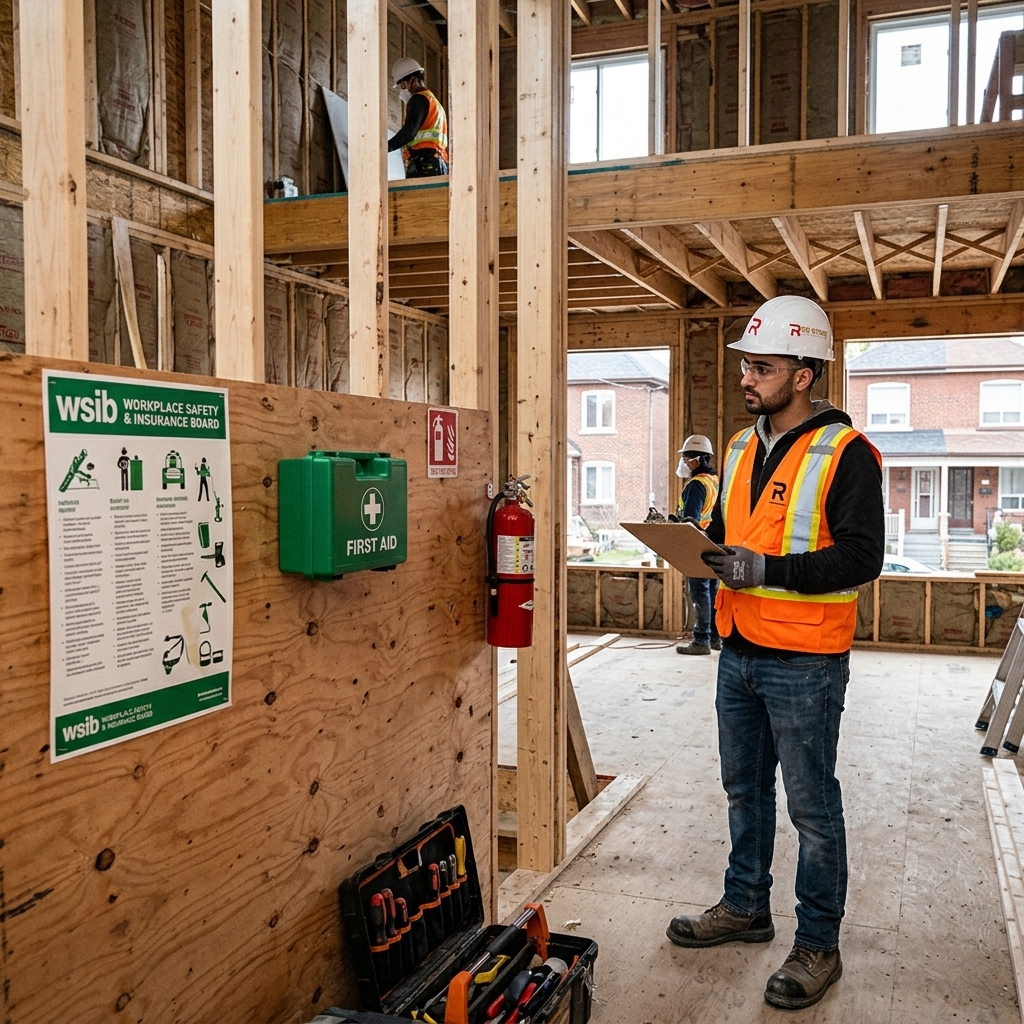
WSIB coverage is Ontario’s workplace injury insurance system. When a contractor is registered with WSIB and their account is in good standing, any worker injured on the job is covered by the WSIB system — meaning the homeowner has no personal liability for workplace injuries that occur on their property during the renovation.
If a contractor is NOT registered with WSIB — or if their account has lapsed due to unpaid premiums — the homeowner may be considered the “employer” under Ontario law and could be held personally liable for workplace injuries. This is not a hypothetical risk; homeowners have been successfully sued for worker injuries on renovation projects where the contractor lacked active WSIB coverage.
To verify WSIB coverage, request the contractor’s WSIB Clearance Certificate. You can also verify their status directly on the WSIB website using their legal business name or WSIB account number. The clearance certificate confirms that the contractor is registered, their account is active, and their premiums are paid up to date.
3. Professional Liability (Errors and Omissions) Insurance
While not mandatory for all renovation contractors, professional liability insurance — also called errors and omissions (E&O) insurance — covers claims arising from design mistakes, incorrect material specifications, or failure to meet building code requirements. This coverage is most important for design-build firms that provide both design and construction services, such as custom home renovation projects where the contractor is responsible for architectural design decisions.
What Insurance You Need as the Homeowner
Updating Your Homeowner’s Insurance During Renovation
Most standard homeowner’s insurance policies include a “course of construction” clause that imposes specific requirements when renovation work is being performed. Failure to notify your insurer about a major renovation can result in a denied claim if damage occurs during or after the project.
Before your renovation begins, contact your homeowner’s insurance provider and inform them of the scope of work, the contractor’s name and insurance details, the expected project duration, and whether the home will be occupied during construction. Your insurer may require you to purchase a builder’s risk policy or a renovation endorsement — additional coverage specifically designed to protect against construction-related losses including theft of building materials, vandalism, and damage from construction activities like fire, water, and wind during the period when the home’s building envelope may be compromised.
Builder’s risk policies for residential renovations typically cost $1,000 to $3,000 for the duration of the project, depending on the renovation value and your home’s assessed value. This is a relatively small investment compared to the catastrophic financial exposure of being uninsured during a major renovation.
Red Flags: Signs Your Contractor May Be Uninsured
- Cash-only pricing with significant discounts: Contractors who insist on cash payments and offer prices dramatically below market rates often operate without insurance, WSIB, or proper business registration to minimize their overhead — and your protection.
- Refusal to provide certificates: A legitimate contractor will provide their COI and WSIB clearance within 24 hours of your request. Any hesitation, delay, or excuse is a major red flag.
- No written contract: An uninsured contractor typically avoids written contracts because a formal agreement creates a documented obligation. Always insist on a detailed written contract specifying scope, pricing, timelines, insurance requirements, and dispute resolution procedures.
- No verifiable business address: Check the Ontario business registry (Business Names Act) to confirm the contractor’s business registration is current. A contractor operating under an unregistered business name may not be insurable.
- Subcontractors without independent coverage: Your general contractor should verify that every subcontractor on your project (electricians, plumbers, tilers, etc.) carries their own CGL and WSIB coverage. If a subcontractor is injured and lacks coverage, the claim may flow upstream to the general contractor — and ultimately to you.
How to Verify Contractor Insurance: Step-by-Step Checklist
- Request the Certificate of Insurance (COI) directly from the contractor’s insurance broker. Verify the policy is current and the limits meet the minimums listed above.
- Request the WSIB Clearance Certificate. Verify independently at wsib.ca that the account is active and in good standing.
- Request proof of vehicle insurance for any company vehicles that will be parked at your property during the project.
- Include insurance requirements in your contract. Specify that the contractor must maintain all required coverage throughout the duration of the project and provide updated certificates if any policy is renewed during the project timeline.
- Notify your own homeowner’s insurer about the renovation scope, timeline, and your contractor’s insurance details.
- Keep copies of all certificates in a dedicated renovation file alongside your contract, permits, and payment records.
Warranty vs. Insurance: Understanding the Difference
A contractor’s warranty covers defects in workmanship and materials that appear after the project is completed — a leaking faucet connection, a cracked tile, peeling paint, or a door that does not close properly. Warranties are only as reliable as the contractor who offers them; if the contractor goes out of business, the warranty becomes worthless.
Insurance, by contrast, covers catastrophic events — injuries, fires, major water damage, structural failures. Insurance is backed by regulated insurance companies with legal obligations to pay valid claims regardless of what happens to the contractor. This is why insurance verification is non-negotiable, while warranty terms are important but secondary.
Construction Liens and How Insurance Protects You
Ontario’s Construction Act allows unpaid subcontractors and material suppliers to register a construction lien against your property — even if you have already paid your general contractor in full. A construction lien can prevent you from selling or refinancing your property until the lien is resolved, which may require additional legal costs of $5,000 to $15,000 or more. Working with a properly insured, financially stable contractor with a track record of paying subcontractors on time dramatically reduces this risk. You can further protect yourself by obtaining a statutory declaration from your contractor confirming that all subcontractors and suppliers have been paid before releasing your final project holdback payment.
For significant renovations, consider requiring your contractor to provide a third-party warranty through an organization like Tarion (for new home construction) or a surety bond. While not common for all renovation projects, a completion bond or performance bond guarantees that the project will be finished even if the contractor defaults — providing an additional layer of financial protection for high-value projects.
What insurance should a renovation contractor have in Ontario?
How do I verify a contractor’s WSIB coverage in Ontario?
Do I need to update my homeowner’s insurance during a renovation?
What happens if my contractor is not insured?
Is contractor insurance the same as a warranty?
Work with a Fully Insured Contractor — Choose Red Stone Contracting
At Red Stone Contracting, transparency is not a marketing claim — it is our operating standard. We provide every client with our full Certificate of Insurance and WSIB Clearance Certificate before any contract is signed. We maintain $5 million in commercial general liability coverage, our WSIB account is in good standing at all times, and every subcontractor on our projects is independently verified for their own insurance and WSIB coverage.
Call us today at (905) 901-1006 or request your consultation online. We will walk you through our insurance documentation, answer your questions, and demonstrate why proper coverage is a cornerstone of professional renovation contracting.
Red Stone Contracting serves Toronto, Oakville, Burlington, and Mississauga with fully insured, WSIB-registered renovation services. Your protection is our priority — before, during, and after every project.