
The porcelain vs ceramic tile decision looks like a simple matter of price and style in the showroom, but the two materials behave quite differently once they are installed. One shrugs off slush, salt and grit at a back door through every winter; the other is lighter, easier to cut and ideal for a glossy backsplash. Choosing well means understanding how each is made, how much water it absorbs, how it wears and what it demands from the floor or wall underneath. The sections that follow cover those differences in practical terms and where each tile belongs, from the front entry to the shower.
Porcelain Vs Ceramic Tile: What Actually Differs
Both are made from clay that is shaped and fired in a kiln. Porcelain uses finer, more refined clays with added minerals, pressed harder and fired at higher temperatures. The result is a denser, harder tile that absorbs very little water. Ceramic tile, in the everyday sense of the word, is fired at lower temperatures from coarser clay, which leaves it more porous, lighter and softer to cut.
The clearest technical line is water absorption. Under the North American tile standard, a tile can be called porcelain only if it absorbs 0.5 percent or less of its weight in water during testing. Non-porcelain ceramic tiles absorb more, and wall tiles in particular can be quite porous. That number matters because it predicts how a tile will handle moisture, staining and freezing.
| Property | Porcelain | Ceramic |
|---|---|---|
| Water absorption | Very low, by definition | Higher, varies by product |
| Density and hardness | Dense, hard, heavy | Lighter, softer body |
| Body | Glazed, colour body or through-body | Usually a glaze over a red or white body |
| Frost resistance | Often rated for freeze and thaw | Generally not suited to freezing exposure |
| Cutting and drilling | Slower; needs wet saws and diamond tooling | Easy to score, snap and drill |
| Typical best uses | Floors, entryways, showers, large format | Walls, backsplashes, light traffic floors |
Choosing between them is part of the wider material planning in any room. If you would like help weighing finishes, sizes and layouts together, our design solutions team can put options side by side with your cabinetry, fixtures and lighting.
Glazed, Colour-Body And Through-Body Tile
Much of the confusion in the porcelain vs ceramic tile comparison comes from the surface, not the body. Three constructions are common:
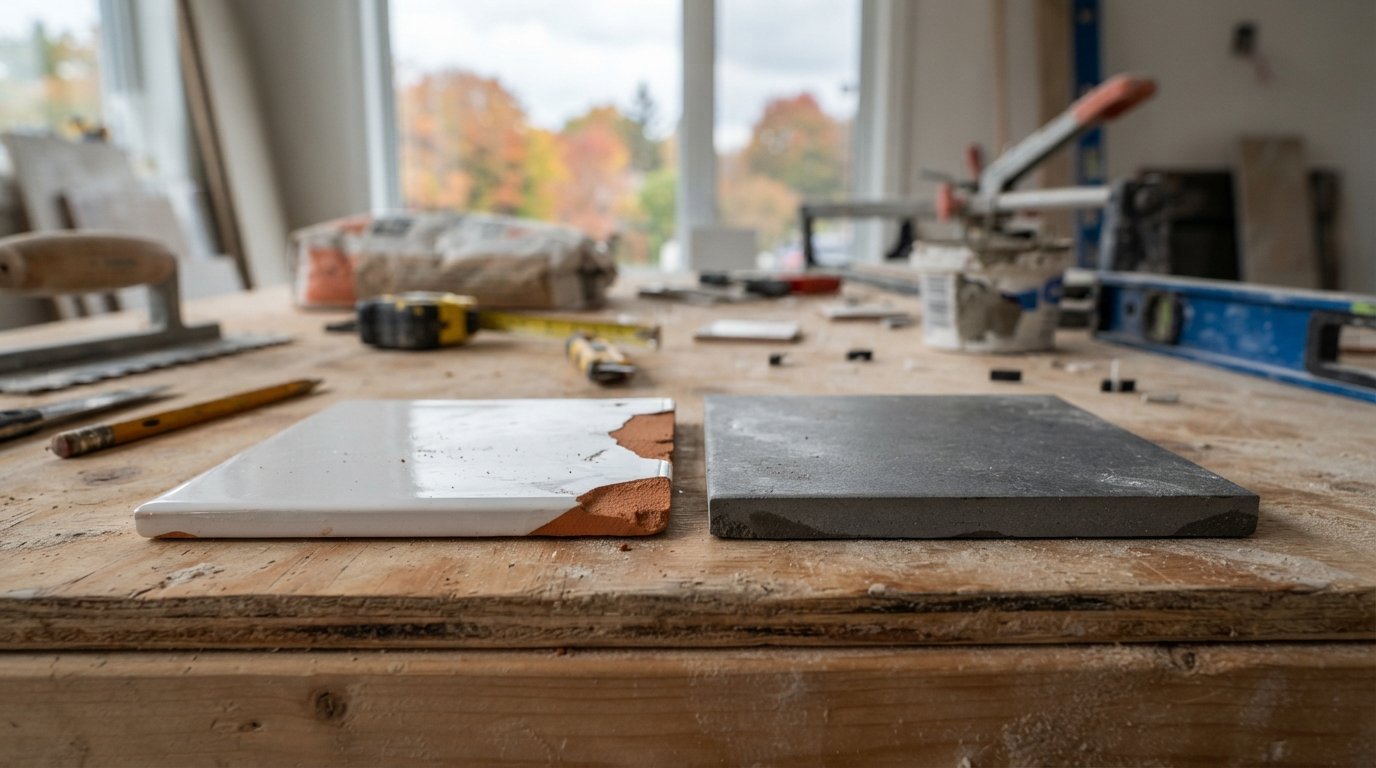
- Glazed tile. A coloured glass-like layer is fused onto the surface. Almost all ceramic tile and much porcelain is glazed. If a glazed tile chips, the different coloured body underneath can show.
- Colour-body porcelain. The glaze sits over a body tinted to a similar colour, so small chips are much less noticeable.
- Through-body porcelain. The colour and pattern run through the full thickness. Chips and wear blend in, which is why it is common in commercial floors. The trade-off is a more limited range of looks than printed glazes.
For glazed tiles, many manufacturers publish a wear classification, often shown as a PEI class, that indicates how well the glaze resists abrasion. Lower classes are intended for walls only, middle classes for residential floors, and higher classes for heavy residential and commercial traffic. A glossy ceramic rated for walls will scratch and dull quickly on a kitchen floor even though it looks identical in the box.
Slip Resistance And Surface Finish
Slip resistance depends on the surface finish, not on whether the tile is porcelain or ceramic. Polished porcelain can be very slippery when wet, while a textured ceramic can grip well. Many manufacturers list a wet dynamic coefficient of friction (DCOF) value, measured under a published standard. For level interior floors that will get wet, look for a product the manufacturer identifies as suitable for that use, and ask the supplier to show you the rating rather than relying on how a tile feels when dry.
- Matte or textured finishes suit entries, mudrooms, bathrooms and kitchens.
- Polished or high gloss finishes are best kept to walls or low risk dry areas.
- Small mosaics on shower floors add grip because of the many grout lines and follow the slope to the drain more easily.
Entryways, Winter Salt And Grit
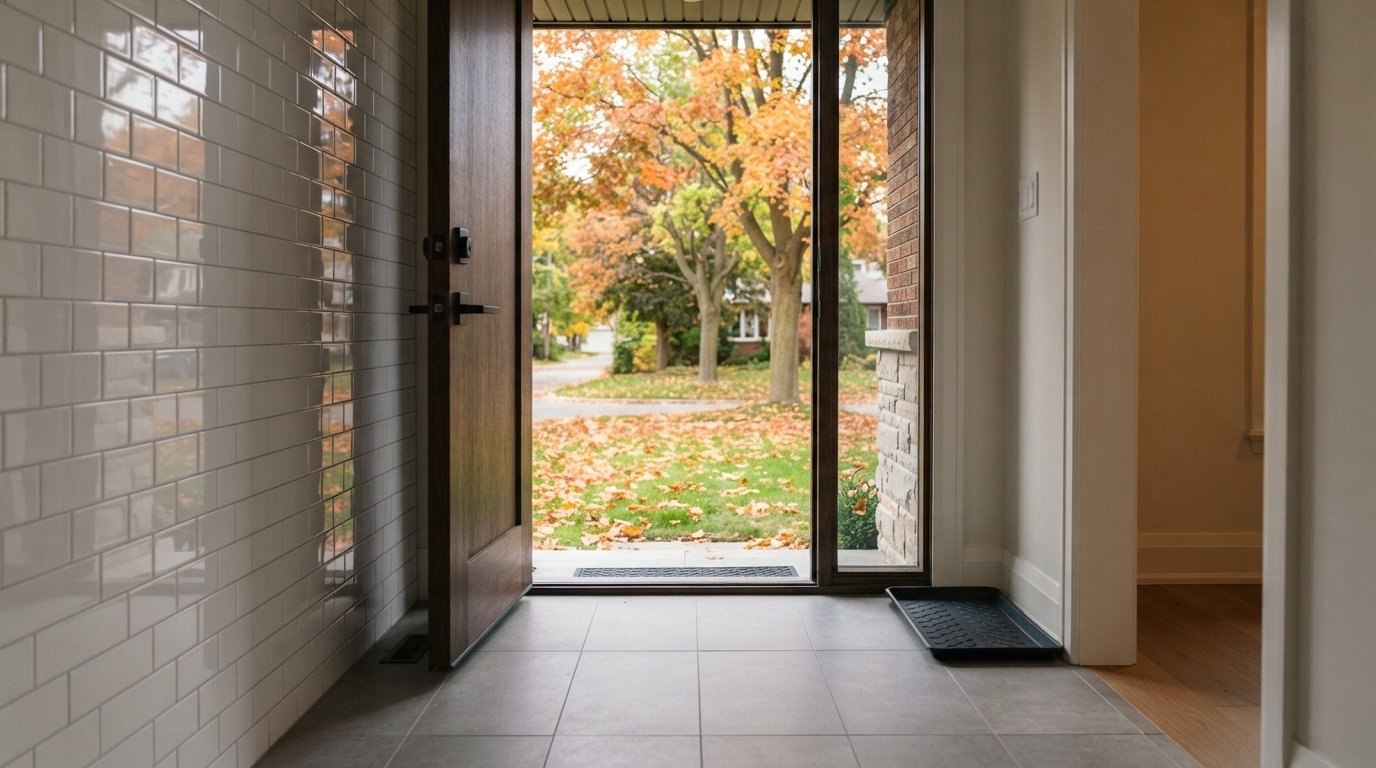
An entry floor in Ontario takes more punishment than any other surface in the house. Once winter arrives it faces slush, de-icing salt, fine grit and the occasional puddle under drying boots, and right now in autumn it already gets wet leaves and muddy shoes. Here the porcelain vs ceramic tile choice is fairly clear: a dense, matte porcelain with a suitable wear rating is usually the better option.
- Grit acts like sandpaper on glossy glazes. A matte or textured porcelain hides wear far better.
- Salt residue leaves a white film on most surfaces; low absorption tile does not soak it in, so it cleans off more easily.
- Grout is the weak point. A darker grout colour, a sealed cement grout or a more stain resistant epoxy or urethane grout keeps the floor looking clean.
- Unheated vestibules and covered porches that get cold need tile rated for freeze and thaw, which usually means frost resistant porcelain, plus setting materials and drainage suited to exterior conditions.
A boot tray zone near the door, with a slight texture, gives slush somewhere to go besides across the floor.
Heated Floors Under Tile
On a heated floor, porcelain vs ceramic tile makes little practical difference: both work well over electric radiant heating because tile conducts heat efficiently. What matters more is installation:
- Follow the heating system’s installation manual for cable spacing, embedding and testing.
- Test the cables before, during and after tiling so a damaged cable is caught before the floor is finished.
- An uncoupling membrane, where the heating system allows it, helps protect tile from movement in the subfloor.
- Thermostat floor sensors should be placed between cable runs as the manufacturer directs.
Heated tile is especially pleasant in bathrooms and entries as the colder months arrive, and it helps dry wet footprints and salt slush faster.
Large-Format Tile And Substrate Flatness
Large porcelain tiles and planks look striking, but they are unforgiving. A small hump or dip in the subfloor that would disappear under 30 centimetre tiles shows up clearly under long planks or big slabs as lippage, where one edge sits higher than the next.
- Flatness tolerances are much tighter for large format tile. Installers often grind high spots and use self-levelling underlayment to bring a floor within the required range.
- Floor stiffness matters. Tile needs a floor with limited deflection, and natural stone needs an even stiffer one. Bouncy floors crack grout and tile.
- Offset patterns. Many long porcelain planks have a slight bow from firing, and manufacturers often recommend limiting the offset in a running pattern, commonly to about a third of the plank length, to reduce lippage.
- Mortar coverage. Large and heavy tiles need appropriate mortar, a large notch trowel and back buttering to reach full coverage.
- Levelling systems. Clip and wedge systems help hold edges flush while the mortar cures.
Wood-look and stone-look porcelain deserve a specific mention, because they are often what tips homeowners toward porcelain in the first place. Rectified edges, ground square at the factory, allow narrow grout joints, but tile should never be butted tight together. The manufacturer sets a minimum joint width, and ignoring it leaves no room for small size variations or movement. Planks also need movement joints at the perimeter and in large rooms, usually hidden under baseboards or set at doorways, so the floor can expand and contract with seasonal changes in the house.
On walls, large porcelain panels are heavy, so the wall must be sound, flat and built to carry the weight. Ceramic wall tile is much lighter and more forgiving on older walls.
Cutting, Installation And Cost Differences
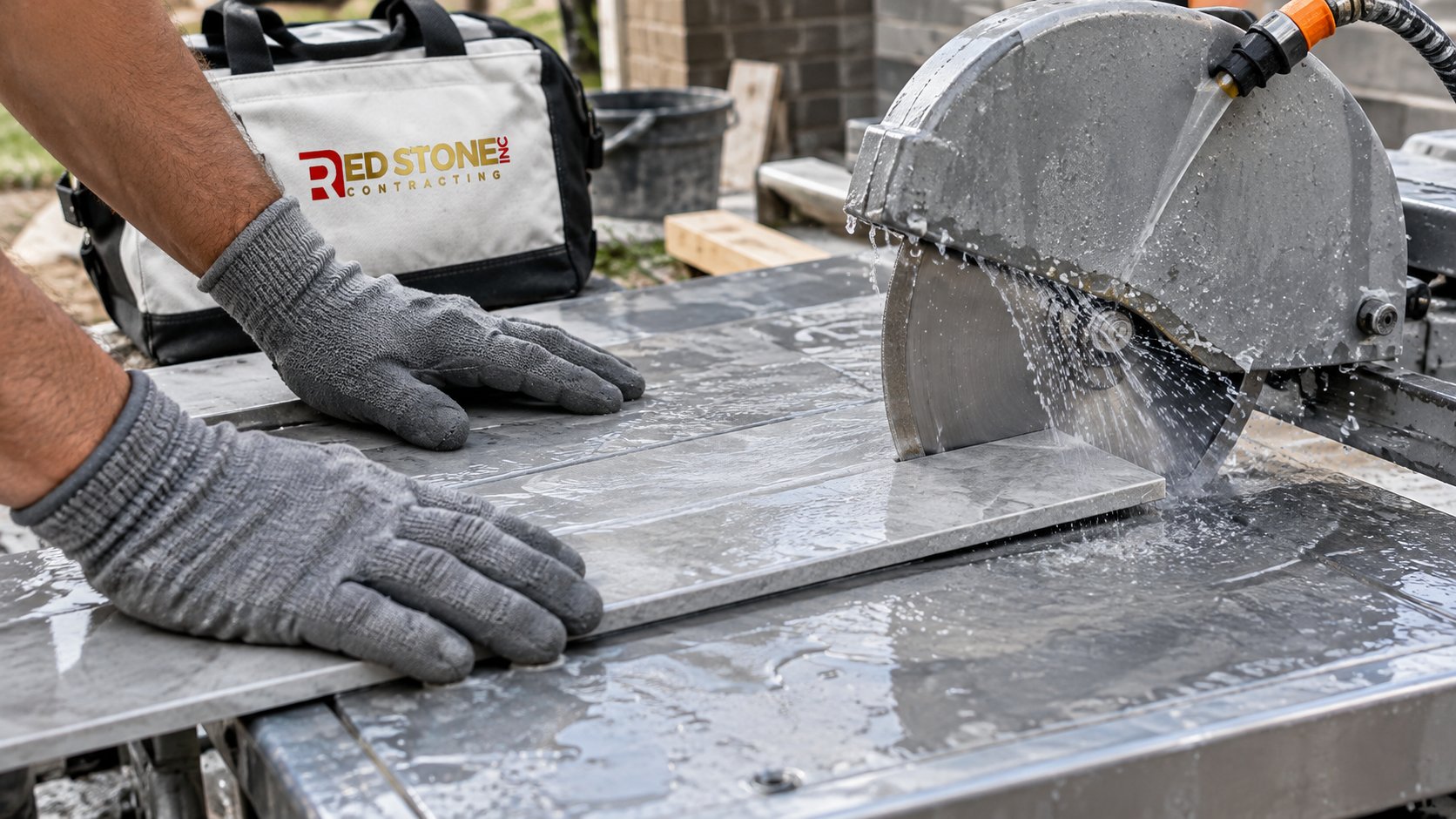
Labour is where the porcelain vs ceramic tile gap often grows. Porcelain is harder, so it takes longer to cut, especially for notches around door casings or holes for plumbing. It needs good wet saws and diamond blades, and drilling requires diamond core bits. Breakage on difficult cuts is more common. Large format porcelain may also need two people to handle, extra floor preparation and specialised mortars.
Ceramic, by contrast, scores and snaps easily, drills quickly and is light to handle, so on a simple wall job the labour gap shrinks considerably. For a backsplash with many outlet cut-outs, it can save noticeable time.
| Item | Rough estimate | Goes up with |
|---|---|---|
| Ceramic tile material | Often $2 to $8 per square foot | Handmade looks, specialty glazes |
| Porcelain tile material | Often $3 to $15 or more per square foot | Large format, through-body, premium brands |
| Standard installation, floor or wall | Often $8 to $15 per square foot | Small rooms, many cuts, patterns |
| Large format porcelain installation | Often $12 to $25 per square foot | Levelling, heavy panels, mitred edges |
| Subfloor levelling and preparation | Quoted by area and condition | Old floors, deflection, self-levelling pours |
All of these are rough estimates; tile choice, layout, room size and the condition of the floor or wall change them.
Where Each Tile Belongs, Room By Room
The porcelain vs ceramic tile question rarely has one answer for a whole house. It is usually settled room by room, sometimes surface by surface within the same room.
| Location | Usual choice | Notes |
|---|---|---|
| Entryways and mudrooms | Matte porcelain | Floor wear rating, stain resistant grout, frost rating if the space gets cold |
| Bathroom floors | Porcelain | Floor rated ceramic also works in a lightly used bathroom |
| Shower walls | Either | The waterproofing behind the tile does the protecting, not the tile |
| Shower floors | Porcelain mosaic or textured porcelain | Small pieces follow the slope and add grip |
| Kitchen backsplash | Ceramic | Light, easy around outlets, wide range of glazes |
| Kitchen floors | Porcelain | Handles dropped pots, chair legs and heavy traffic |
| Covered porches and exterior steps | Frost rated porcelain only | Exterior grade setting materials and drainage required |
Wall tile versus floor tile
Tile sold as wall tile should stay on walls. Its body is often softer and more porous, and its glaze is not designed for foot traffic. Floor tile can go on walls, but heavier porcelain needs a sound, flat substrate and the right mortar, and large panels on walls take more skill to set. Trim is another practical difference. Many ceramic wall tile lines include matching bullnose and edge pieces, while many porcelain lines rely on metal or PVC edge profiles to finish exposed edges. Check what finishing pieces exist before falling in love with a tile for a shower niche or an open backsplash end.
Clients of our Peel Region home renovation team often end up mixing both: porcelain underfoot and ceramic on the walls, matched in colour so the room still reads as one design.
Long Term Care, Spares And Repairs
Day to day care is similar for both materials: sweep grit regularly, mop with a pH neutral cleaner and avoid harsh acids on grout. Glazed tile, ceramic or porcelain, does not need sealing. Some unglazed or polished porcelain benefits from a sealer, so follow the manufacturer’s guidance. Cement based grout is porous and is often sealed, while epoxy and some urethane grouts are not.
Plan for the day a tile cracks. Tile is made in production runs, and each run can vary slightly in shade and in actual size, often marked on the box as a lot or calibre number. Keep a box or two of spare tile from the same lot, labelled and stored somewhere dry. Replacing a single tile later is possible with either material, but dense porcelain is harder to cut out cleanly without damaging its neighbours, so a skilled repair matters. When ordering, buy enough to cover the measured area, cut waste and those spares at the same time, and check that every box carries the same lot number before installation starts.
Thinking about the long term is often what tips the porcelain vs ceramic tile decision for a floor: a slightly higher cost now in exchange for a surface that looks the same in fifteen years.
What To Check On The Box And The Spec Sheet
- Is this tile certified as porcelain, and what is its wear rating for floors?
- What slip resistance information is published for wet areas?
- Is it rated for freeze and thaw if it is going in a cold space?
- What substrate flatness and floor stiffness does this format need, and how will you achieve it?
- Which grout do you recommend for this room, and does it need sealing?
Porcelain Vs Ceramic Tile: Quick Answers
Is porcelain always better than ceramic?
Can ceramic tile go on a floor?
Which tile is best for an entryway with winter salt?
Does porcelain work with heated floors?
Why is porcelain more expensive to install?
Is porcelain tile slippery?
Get The Porcelain Vs Ceramic Tile Choice Right
The right tile in the right place will look good and wear well for decades. Red Stone Contracting will walk through materials with you room by room, prepare floors and walls properly and install tile that suits how your household lives.
Call us today at (905) 901-1006 or request a free estimate.
Tiling kitchens, bathrooms and entries for homeowners in Peel Region and the wider GTA.