
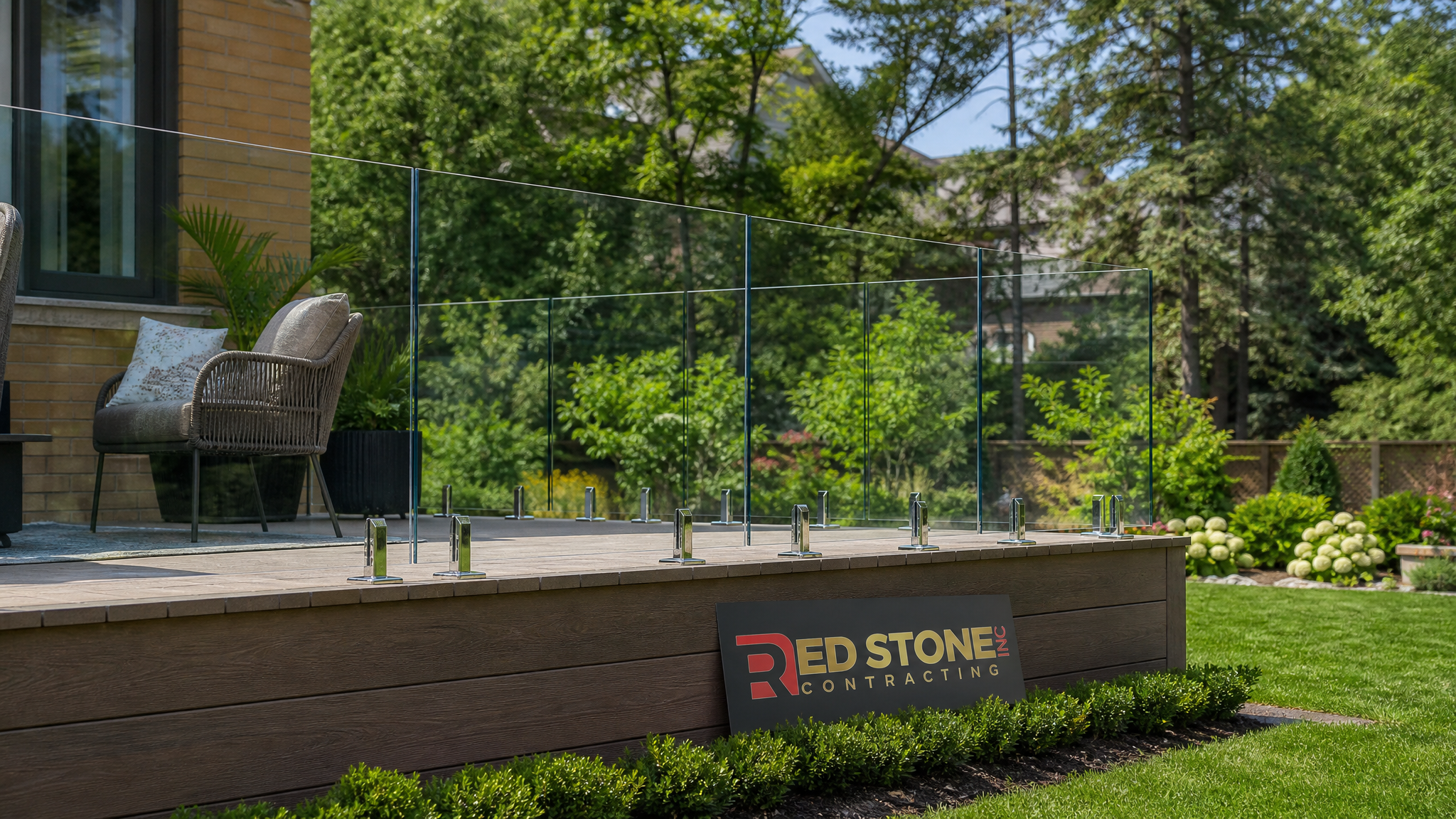
If you have been considering glass railing installation in Toronto, summer 2026 is one of the best times to move forward. Long daylight hours, dry curing conditions for structural adhesives, and a full season ahead to enjoy your new deck, staircase, or balcony all make June through August the ideal installation window. Whether you are upgrading an interior staircase, enclosing a second-storey deck, or finishing a new home addition, glass railings deliver unobstructed sightlines, a sleek contemporary aesthetic, and lasting durability that blends beautifully with Toronto and GTA home styles.
This guide covers everything homeowners across the GTA need to know about glass railing installation in Toronto in 2026: realistic cost ranges, the difference between framed, semi-frameless and frameless systems, Ontario Building Code compliance, summer-specific considerations, and how to choose a qualified contractor. From Mississauga to Markham, Vaughan to Burlington, glass railings are among the fastest-growing renovation requests we receive at Red Stone Contracting.
Why Glass Railing Installation in Toronto Is Booming in 2026
Toronto’s residential renovation market has seen glass railings move from a luxury niche to a mainstream upgrade over the past three years. Several converging trends explain the surge. First, open-concept interior renovations — particularly custom home renovations that remove walls between living areas — demand railings that do not visually cut a room in half. Second, deck and outdoor living investment has accelerated sharply post-pandemic as homeowners prioritise private outdoor space, and glass panels allow decks to feel expansive even in modest GTA backyards. Third, the resale premium is measurable: real estate agents consistently note that glass railings photograph well and signal quality workmanship to buyers.
There is also a practical summer angle. Glass panels allow summer breezes to pass through to some degree on lower-profile framed systems, but the key summer benefit is visual openness. A traditional wood or aluminum spindle railing on a deck chops your garden view into vertical slices. A glass panel gives you a continuous, uninterrupted panorama of your landscaping, pool, or green space — precisely what you want on a warm June evening. For second-floor and rooftop applications, the safety of a certified glass barrier is paired with the pleasure of a view that feels almost like no barrier at all.
Glass railing installation in Toronto also pairs naturally with other warm-weather projects. Many homeowners bundle a glass railing upgrade with a deck resurfacing, a pergola addition, or a home addition project. Coordinating trades during summer simplifies scheduling and often reduces overall project cost.
Types of Glass Railing Systems Available in Toronto
Not all glass railings are the same. The system type affects cost, installation complexity, code compliance pathway, and visual outcome. Understanding the three main categories helps you have an informed conversation with your contractor.
Framed glass railings enclose each panel within an aluminum or stainless steel frame on all four sides. The frame provides structural redundancy, making these the easiest systems to certify under Ontario Building Code requirements. They are also the most budget-friendly option. The visual result is cleaner than traditional spindles but retains visible hardware. Framed systems are common in commercial and multi-residential settings but remain popular for residential decks where budget is a priority.
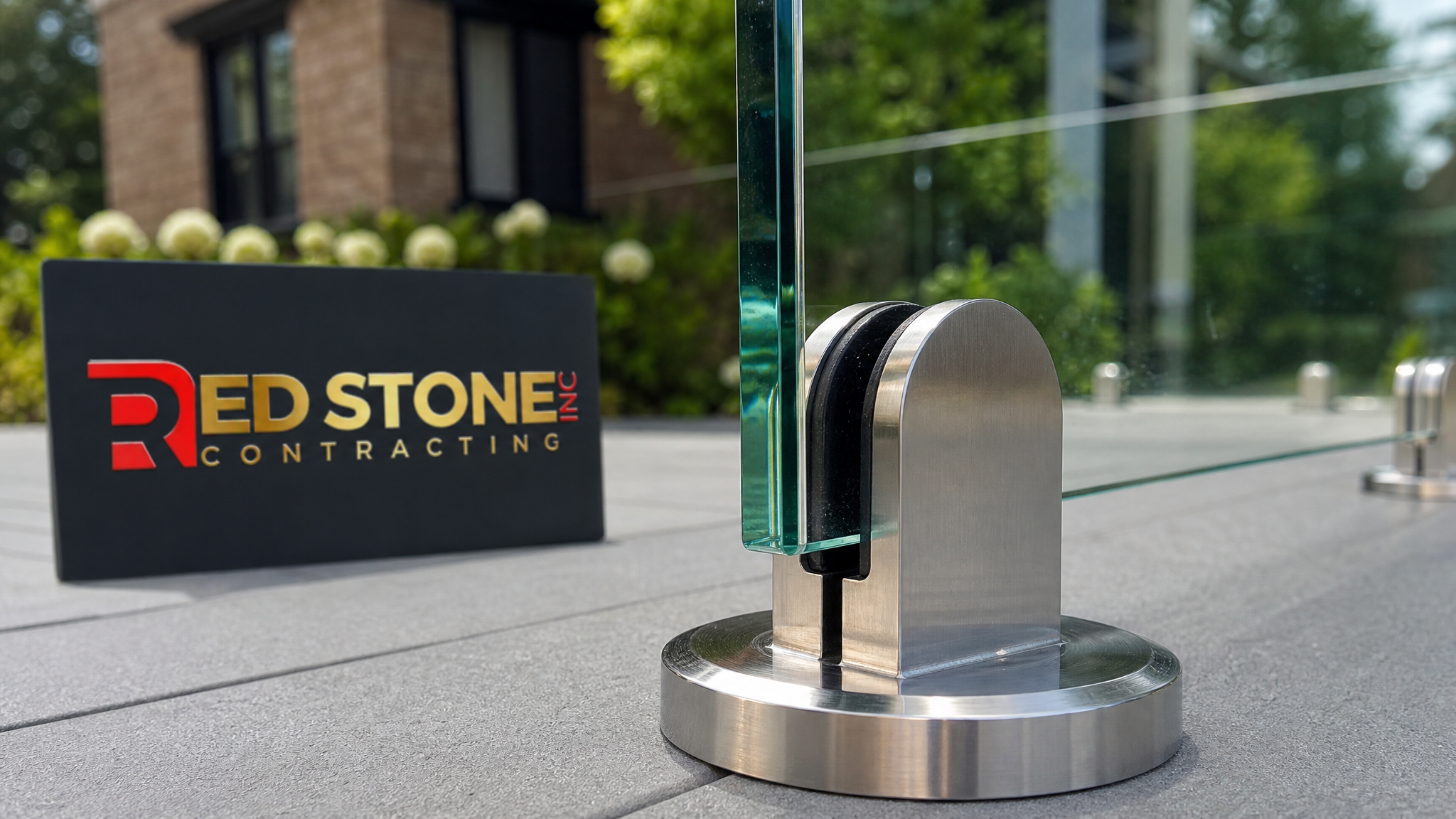
Semi-frameless glass railings use vertical posts (typically at 900 mm to 1,200 mm centres) with no horizontal framing members between the glass and the top cap rail. The panels are held in post-mounted clamps or channels, producing a much cleaner look than fully framed systems. Most residential glass railing installations in Toronto fall into this category. Post materials include powder-coated aluminum (most popular due to corrosion resistance in GTA freeze-thaw cycles), brushed stainless steel, and black matte aluminum.
Frameless glass railings eliminate visible posts by anchoring panels via heavy stainless steel base spigots or a continuous bottom channel embedded in the deck or floor. The result is the purest glass-forward aesthetic — panels appear to float. Frameless systems require thicker tempered glass (typically 12 mm or 15 mm) and more precise substrate preparation, which drives up both material and labour costs. They are the preferred choice for high-end interior staircases, rooftop decks, and luxury home renovations where visual impact is paramount.
| System Type | Typical Glass Thickness | Post / Frame Material | Visual Impact | Relative Cost (per linear metre) |
|---|---|---|---|---|
| Framed | 6 mm – 8 mm tempered | Aluminum alloy frame | Clean but structured | $250 – $400 |
| Semi-frameless | 10 mm – 12 mm tempered | Aluminum or stainless posts | Open, minimal hardware visible | $400 – $650 |
| Frameless (spigot) | 12 mm – 15 mm tempered | Stainless steel spigots | Maximum visual openness | $600 – $950 |
| Frameless (channel) | 12 mm – 15 mm tempered | Embedded base channel | Cleanest appearance | $700 – $1,100 |
| Cable + glass hybrid | 8 mm tempered infill panels | Stainless cable posts | Industrial / contemporary mix | $350 – $550 |
Glass Railing Installation Toronto Cost Breakdown for 2026
Homeowners across the GTA consistently underestimate the total installed cost of glass railings because they focus on the glass panel price alone. A realistic budget must account for materials, hardware, substrate preparation, labour, permits where required, and applicable HST. The following figures are based on current Toronto-area contractor pricing as of June 2026.
For a typical semi-frameless outdoor deck railing on a 10-metre run, expect to pay between $5,500 and $8,500 fully installed. This range reflects standard-grade tempered glass panels, black powder-coated aluminum posts, a brushed aluminum top rail, and standard concrete or wood-deck post anchoring. Premium stainless hardware, tinted glass, or custom curved sections add cost. Interior staircase applications often run higher per linear metre because of the precision required to accommodate stair angle, nosing depth, and hardwood newel integration.
Permit costs in the City of Toronto vary by project scope. Deck railing replacements on existing permitted decks are often covered by the original deck permit or a minor repair permit. New construction railings, second-storey balconies, and rooftop applications typically require a standalone building permit. Budget $300 to $600 for permit fees plus engineering drawings if required for frameless systems.
| Cost Component | Low Estimate | Mid Estimate | High Estimate | Notes |
|---|---|---|---|---|
| Tempered glass panels (per m²) | $95 | $140 | $210 | Thickness, tint, low-iron options |
| Aluminum posts and top rail (per lin. m) | $80 | $120 | $180 | Powder-coat colour affects price |
| Stainless steel spigots (frameless) | — | $60/unit | $95/unit | Typically 1 spigot per 600 mm panel |
| Labour – installation (per lin. m) | $120 | $170 | $250 | Interior stairs at high end |
| Substrate prep / blocking | $0 | $350 | $900 | Depends on existing deck structure |
| Permit and drawings | $0 | $400 | $800 | Required for most new installations |
One cost factor specific to summer installation is the potential for expedited scheduling. Contractor availability in June and July 2026 remains strong through mid-July before the August crunch, when demand for outdoor renovations peaks ahead of fall. Booking your glass railing installation in Toronto before the end of June often secures better lead times on custom glass orders, which typically take two to four weeks to fabricate once panel dimensions are confirmed.
Ontario Building Code Requirements for Glass Railings
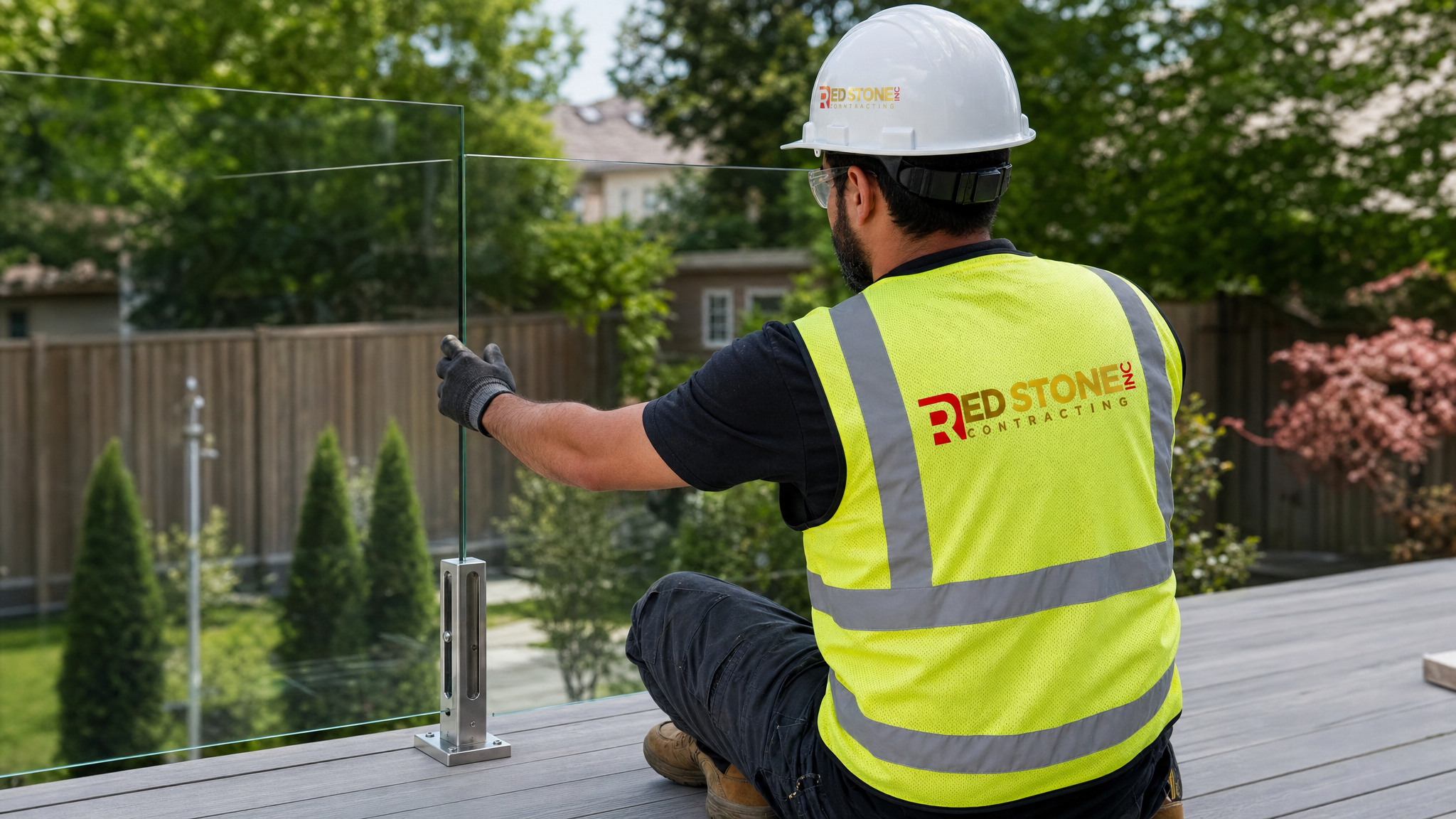
Compliance with the Ontario Building Code (OBC) is not optional, and any reputable glass railing contractor in Toronto will be familiar with the relevant sections. The key code requirements for residential glass railing installation in Toronto are straightforward once you understand the framework.
Guard height: For floors, decks, and balconies more than 600 mm above the adjacent grade or floor level, a guard (railing) is required. For most residential applications at heights up to 1,800 mm, the minimum guard height is 900 mm. For anything above 1,800 mm drop height, the minimum increases to 1,070 mm. Many Toronto homeowners opt for 1,070 mm as a standard regardless of height, both for safety margin and for aesthetic proportionality.
Glass specification: The OBC requires that glass used in guards be laminated glass, tempered glass, or wired glass meeting the requirements of CAN/CGSB-12.1 (tempered glass) or CAN/CGSB-12.11 (wired glass). Most residential glass railing installation in Toronto uses heat-strengthened tempered or laminated tempered glass. Laminated tempered (two layers bonded with a PVB interlayer) is increasingly preferred because when broken, the fragments adhere to the interlayer rather than falling as loose shards — a meaningful safety advantage for second-storey applications.
Structural load requirements: Guards must resist a horizontal concentrated load of 0.9 kN (approximately 90 kg) applied at the top of the guard at any point, and a distributed load of 0.75 kN/m applied horizontally. For frameless spigot systems, engineering sign-off confirming that the spigot spacing, embedment depth, and glass thickness satisfy these loads is typically required as part of the permit submission.
Opening limitations: The OBC specifies that openings in guards must not allow passage of a 100 mm sphere. This rules out wide horizontal spacing in cable or bar railing systems but is inherently met by glass panel systems, since a continuous panel has no openings. This makes glass railings one of the easiest system types to satisfy this specific code requirement.
For homeowners in Mississauga, Brampton, and Vaughan, the applicable Building Code is the same OBC, but the local municipality’s building department administers permits and inspections. Processing times vary: the City of Toronto’s permit portal processes minor railing permits in five to fifteen business days; Mississauga and Brampton typically run seven to twelve business days. Oakville and Burlington often have faster turnaround for single-family residential work.
Indoor vs Outdoor Glass Railing Installation: Key Differences
While the visual language of glass railings is consistent indoors and out, the technical requirements diverge in important ways. Understanding these differences helps you set realistic expectations and ensures your contractor is specifying the right products for each environment.
Substrate and anchoring: Indoor staircases are anchored into hardwood or engineered wood flooring over a structural floor system. Post base plates must be positioned to land on joists or blocking, which requires careful layout before any holes are drilled. Outdoors, posts are anchored into concrete footings, PT (pressure-treated) deck framing, or concrete slabs. Summer installation is advantageous outdoors because concrete anchoring compounds cure faster in warm temperatures — a slow-set anchor epoxy that takes 24 hours at 10°C typically reaches full strength in four to six hours at 25°C.
Glass treatment: Outdoor glass should be specified with a hydrophobic nano-coating (sometimes called “easy clean” glass) that causes water to bead and run off rather than sheeting and leaving mineral deposits. In Toronto’s summer, afternoon thunderstorms can coat unprotected glass with hard water residue within days of installation. A factory-applied coating at the time of manufacture is far more effective than aftermarket topical treatments. Indoor glass does not require weather-resistance coatings but benefits from a glare-reduction treatment on south-facing staircase applications where summer sunlight can create strong reflections.
Fastener and hardware specification: Outdoor hardware must be either marine-grade stainless steel (316 SS) or powder-coated aluminum with appropriate gaskets to prevent galvanic corrosion. Even in a non-coastal environment like Toronto, the combination of summer humidity, winter road salt, and acid rain creates a corrosive microenvironment at hardware contact points. Specifying 304 SS or uncoated mild steel hardware outdoors is a common cost-cutting mistake that leads to rust streaking on glass panels within two to three years. Indoor hardware can use 304 SS or high-quality aluminum without concern for external corrosion.
| Specification Factor | Indoor Staircase / Mezzanine | Outdoor Deck / Balcony | Rooftop / High Exposure |
|---|---|---|---|
| Glass type | 10 mm tempered or laminated tempered | 10–12 mm tempered or laminated tempered | 12–15 mm laminated tempered |
| Glass coating | Optional anti-glare | Hydrophobic nano-coating recommended | Hydrophobic nano-coating required |
| Post / hardware material | 304 SS or powder-coat aluminum | 316 SS or powder-coat aluminum | 316 SS exclusively |
| Anchor type | Post base to blocking, wood screws | Epoxy anchor into concrete or lag into PT lumber | Through-bolt with structural backing plate |
| Permit typically required | Yes for new installation | Yes — standalone or deck permit | Yes — often with engineering |
| Average install time (10 lin. m) | 1.5 – 2 days | 1 – 1.5 days | 2 – 3 days |
For homeowners pursuing a full interior renovation that includes an open staircase with a glass railing, our design solutions team can coordinate the glass railing specification as part of a broader interior design package, ensuring that the hardware finish, glass tint, and newel post details align with the rest of your renovation. This integrated approach avoids the common problem of a beautiful glass railing that looks disconnected from the surrounding finishes.
Choosing the Right Glass: Tempered, Laminated, Tinted and Low-Iron Options
The glass specification is the most consequential decision in any glass railing project, yet it is often left entirely to the contractor. An informed homeowner who understands the options can make choices that align with their priorities — safety, aesthetics, maintenance, and budget.
Tempered glass is the code-minimum standard for glass guards in Ontario. It is heated to approximately 620°C and then rapidly cooled, creating a glass that is four to five times stronger in bending than standard annealed glass. When broken, it fractures into small, relatively harmless granular fragments rather than large, sharp shards. Tempered glass cannot be cut or drilled after tempering — all holes and notches must be specified before fabrication — which means your contractor must have accurate measurements before ordering.
Laminated tempered glass adds a PVB (polyvinyl butyral) interlayer between two tempered panes. If broken, the fragments adhere to the interlayer, maintaining the panel’s structural form and preventing falling glass. This is the preferred specification for overhead glazing, second-storey balconies, and any application where falling glass could injure people below. The premium over standard tempered is typically $25 to $45 per m², well worth it for elevated applications.
Tinted glass (bronze, grey, blue-green) can reinforce a design direction and reduce glare on south and west-facing decks. Tinted panels on summer afternoons meaningfully reduce the greenhouse effect on enclosed balconies. The trade-off is that tinted glass absorbs more solar heat, which can slightly increase the surface temperature of the glass itself — a consideration for south-facing indoor installations where heat gain may be an issue. For outdoor decks, this is rarely a problem because any accumulated heat dissipates quickly in open air.
Low-iron glass (sometimes called “ultra-clear” or “starphire”) removes the greenish tint inherent in standard float glass, producing a crystal-clear panel with near-perfect colour neutrality. Standard tempered glass has a green edge cast that is visible at the glass edges and on thicker panels. Low-iron glass eliminates this, which matters most on frameless systems where the glass edge is prominently visible. The premium is approximately $30 to $60 per m² over standard clear tempered. For high-end interior staircases and pool surround applications, low-iron glass is almost always worth the upgrade.
If your home renovation touches multiple areas — for instance, a kitchen that opens to a rear deck accessed via a glass-railed staircase — bundling the glass railing work with your kitchen renovation project allows for a coordinated design and a more efficient construction schedule. We can plan the staircase and deck railing details in parallel with interior finishes so the result reads as a cohesive whole rather than a series of disconnected upgrades.
Maintenance, Cleaning and Summer UV Considerations
One of the most compelling arguments for glass railings — and one that resonates strongly with Toronto homeowners — is low long-term maintenance compared to wood, wrought iron, or even aluminum spindle railings. Wood railings require sanding, staining or painting every two to four years, and are susceptible to rot, warping, and insect damage in GTA humidity. Wrought iron corrodes. Aluminum spindles collect grime in their hollow sections. Glass, properly installed with high-quality hardware, requires only periodic cleaning.
For summer maintenance, the primary issue is water spotting from Toronto’s hard municipal water and from the mineral-rich runoff off roofing materials during summer rainstorms. The best practice is to clean glass panels with a squeegee and a mild dilute white vinegar solution (1 part vinegar to 4 parts distilled water) after heavy rain events. This removes mineral deposits before they bond to the glass surface. Avoid abrasive cleaners or steel wool — even micro-scratches on tempered glass create nucleation points that can, over time, contribute to spontaneous thermal breakage in high sun exposure conditions.
UV exposure is a legitimate consideration for two components: rubber or EPDM gaskets used in framed and semi-frameless systems, and PVB interlayers in laminated glass. High-quality installation uses UV-stable EPDM gaskets rather than standard rubber, which degrades and becomes brittle after two to three Toronto summers. For laminated glass, reputable manufacturers use UV-stable PVB formulations tested to resist delamination for 20 years or more under direct sun exposure. Ask your contractor to confirm the UV stability rating of any PVB product specified.
Post and hardware finishes hold up well in summer heat. Powder-coated aluminum expands minimally at GTA summer temperatures (typically 25°C to 35°C ambient, up to 60°C surface temperature on south-facing black metal in direct sun). This is well within the performance range of quality polyester powder coatings, which are rated to 120°C continuous service temperature. Stainless steel hardware is similarly unaffected. The only summer-specific maintenance note for hardware is to wipe down exposed stainless surfaces with a stainless cleaner once or twice a season to prevent surface oxidation (“tea staining”) that can occur on lower grades of stainless in humid urban environments.
For homeowners who also have bathroom spaces adjacent to open stairways — a common configuration in Toronto semi-detached and detached homes — a glass railing on the landing can extend the visual openness of a recently renovated bathroom area. Our bathroom renovation projects frequently include glass railing coordination for connected staircase landings as part of the overall project scope.
How much does glass railing installation in Toronto cost in 2026?
Do I need a building permit for glass railing installation in Toronto?
What type of glass is used in glass railing installation Toronto projects?
How long does glass railing installation take?
Is glass railing installation in Toronto suitable for homes with children and pets?
How do I maintain glass railings through summer in Toronto?
Schedule Your Glass Railing Installation Consultation Today
A well-executed glass railing transforms staircases, decks, and balconies into architectural features that add long-term value and everyday pleasure to your home. Red Stone Contracting brings deep technical knowledge of OBC compliance, material specification, and installation craft to every glass railing project across the GTA. Our team handles the full process — site measurement, glass order management, permit applications, structural anchoring, and final inspection — so you do not have to coordinate multiple trades or navigate the code requirements alone. Summer 2026 is an ideal time to move forward while weather conditions, fabrication lead times, and contractor availability are all aligned.
Call us today at (905) 901-1006 or request a free consultation to get started.
Red Stone Contracting proudly serves Toronto, Mississauga, Vaughan, Markham, Brampton, Oakville, and Burlington.