
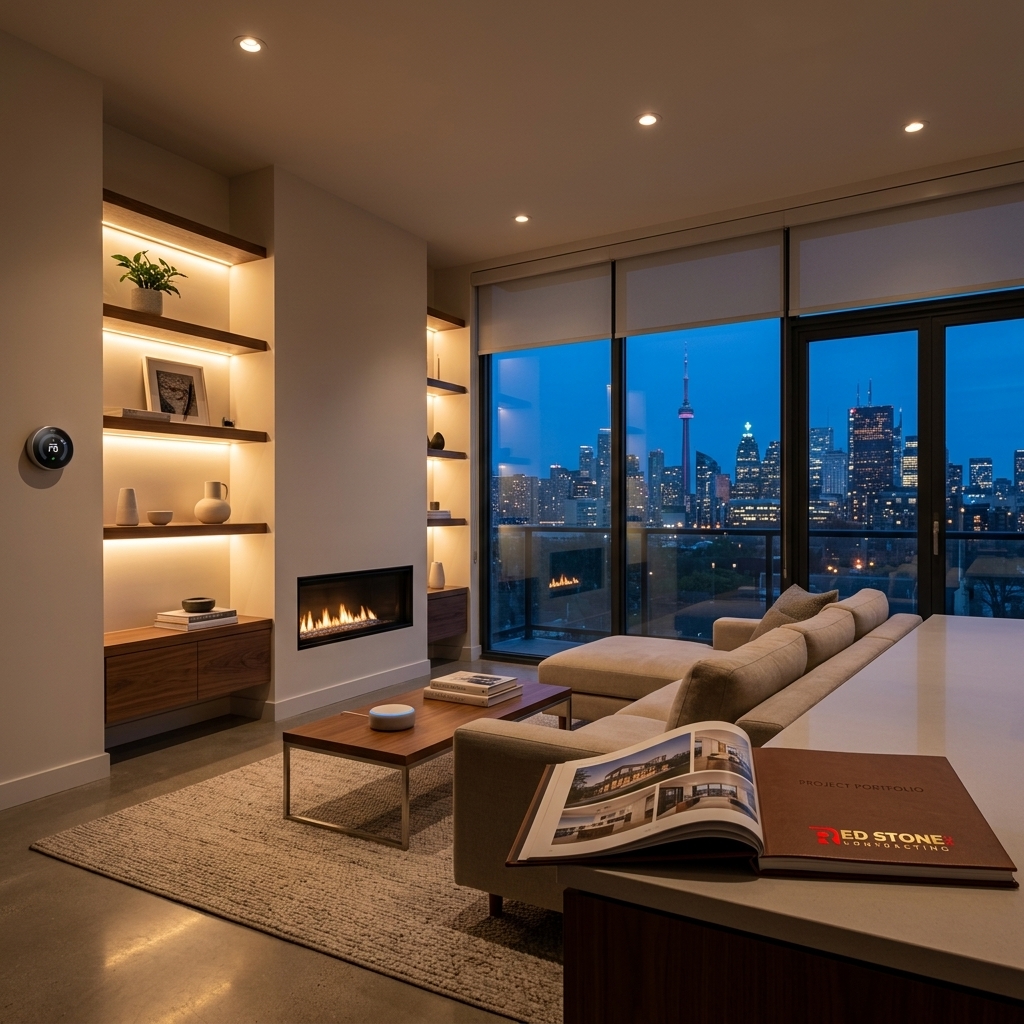
Technology is no longer an afterthought bolted onto a finished home — it is now a foundational layer that must be planned and integrated during the renovation process itself. A true smart home renovation toronto project goes far beyond screwing in a few smart bulbs or plugging in a voice assistant. It requires structured wiring infrastructure, centralized control systems, and careful coordination between your renovation contractor, electrician, and technology integrator. This comprehensive 2026 guide explains how to properly integrate smart home technology into your Toronto home upgrade, covering everything from network infrastructure and lighting control to security, climate management, and the realistic costs involved.
Why Smart Home Renovation Toronto Homeowners Should Plan Technology During Construction
The single most important principle of smart home integration is this: infrastructure must be installed during construction, not after. Once drywall is closed, running new wiring becomes exponentially more expensive and disruptive. A custom home renovation that includes smart home planning from the design phase can integrate technology seamlessly and invisibly, with all wiring concealed inside walls and all devices flush-mounted for a clean, premium aesthetic.
Retrofitting smart home technology into a finished home is possible but limited. Wireless devices like smart bulbs, plug-in sensors, and battery-powered cameras work without new wiring, but they depend on Wi-Fi reliability, require battery maintenance, and lack the polish of hardwired installations. For homeowners already investing in a renovation — whether it is a kitchen renovation, bathroom renovation, or whole-home remodel — integrating smart infrastructure during the open-wall phase adds relatively little cost while delivering dramatically better long-term performance.
The Foundation: Structured Wiring and Network Infrastructure
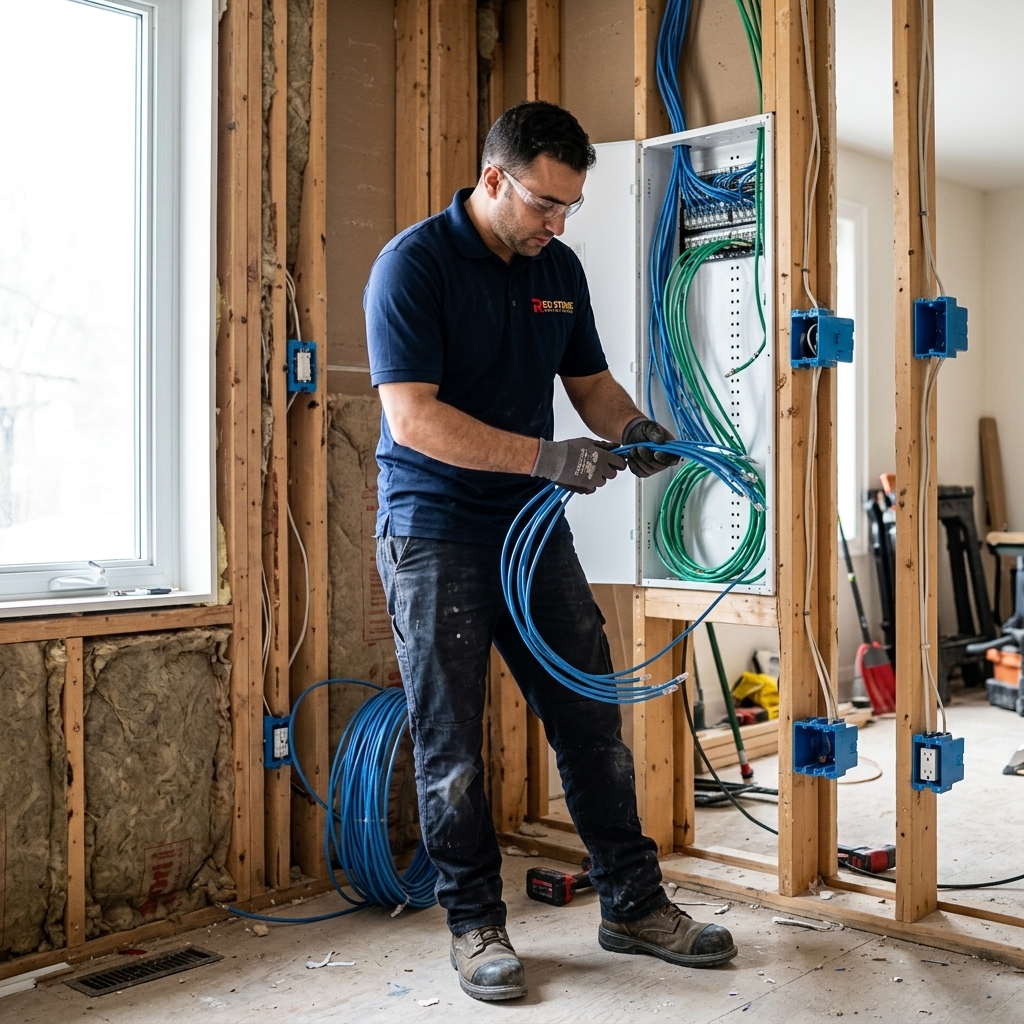
Every smart home depends on a reliable, high-speed network. The foundation of that network is structured wiring — a centralized system of ethernet cables, coaxial cables, and low-voltage wiring that runs from a central distribution panel to every room in the house.
| Infrastructure Component | Purpose | Estimated Cost |
|---|---|---|
| Structured Media Panel | Central hub where all ethernet, coax, and low-voltage cables terminate. Typically installed in a basement utility closet. | $300 – $600 |
| Cat6A Ethernet Runs (per drop) | Hardwired network connections for TVs, access points, security cameras, and desktop computers. Faster and more reliable than Wi-Fi. | $150 – $250 per run |
| Wireless Access Points (ceiling-mounted) | Enterprise-grade Wi-Fi access points (Ubiquiti, TP-Link Omada) mounted in ceilings for blanket wireless coverage throughout the home. | $150 – $300 per unit |
| Network Switch and Router | Managed switch distributes wired connections; router manages internet traffic and security. | $200 – $500 |
| Low-Voltage Conduit | Empty conduit tubes run through walls for future-proofing — allows new cables to be pulled later without opening walls. | $100 – $200 per run |
For a typical three-bedroom Toronto home, a comprehensive structured wiring package with 12 to 16 ethernet drops, three ceiling-mounted access points, and a managed network switch costs approximately $3,000 to $5,500 installed during construction. This same installation after drywall is closed would cost $8,000 to $12,000 due to the labour required to fish cables through finished walls.
Smart Lighting: The Highest-Impact Upgrade
Lighting control is universally considered the single highest-impact smart home upgrade because it fundamentally changes how every room in the house feels and functions. Smart lighting allows you to create scenes — preset combinations of brightness, colour temperature, and which fixtures are active — that can be triggered by voice, a wall switch, a phone app, or automated schedules.
Hardwired vs. Smart Bulb Approaches
Smart switches (Lutron Caseta, Lutron RadioRA3): These replace your standard wall switches and control conventional LED bulbs. This is the professional approach because it works with any bulb, does not depend on Wi-Fi (Lutron uses its own ClearConnect radio frequency), and maintains normal switch functionality even if the network goes down. Cost: $80 to $250 per switch depending on the system.
Smart bulbs (Philips Hue, LIFX): Individual bulbs that connect via Zigbee, Bluetooth, or Wi-Fi. They offer colour-changing capabilities but require the wall switch to remain in the “on” position at all times — if someone flips the switch off, the smart bulb loses power and becomes unresponsive. This approach works for accent lighting but is not recommended as a whole-home strategy.
For a comprehensive lighting control system covering a typical Toronto home with 30 to 40 lighting zones, a Lutron Caseta system costs approximately $4,000 to $7,000 installed, while a premium Lutron RadioRA3 system ranges from $8,000 to $15,000. Both integrate with all major voice assistants and home automation platforms.
Climate Control: Smart Thermostats and Zoning
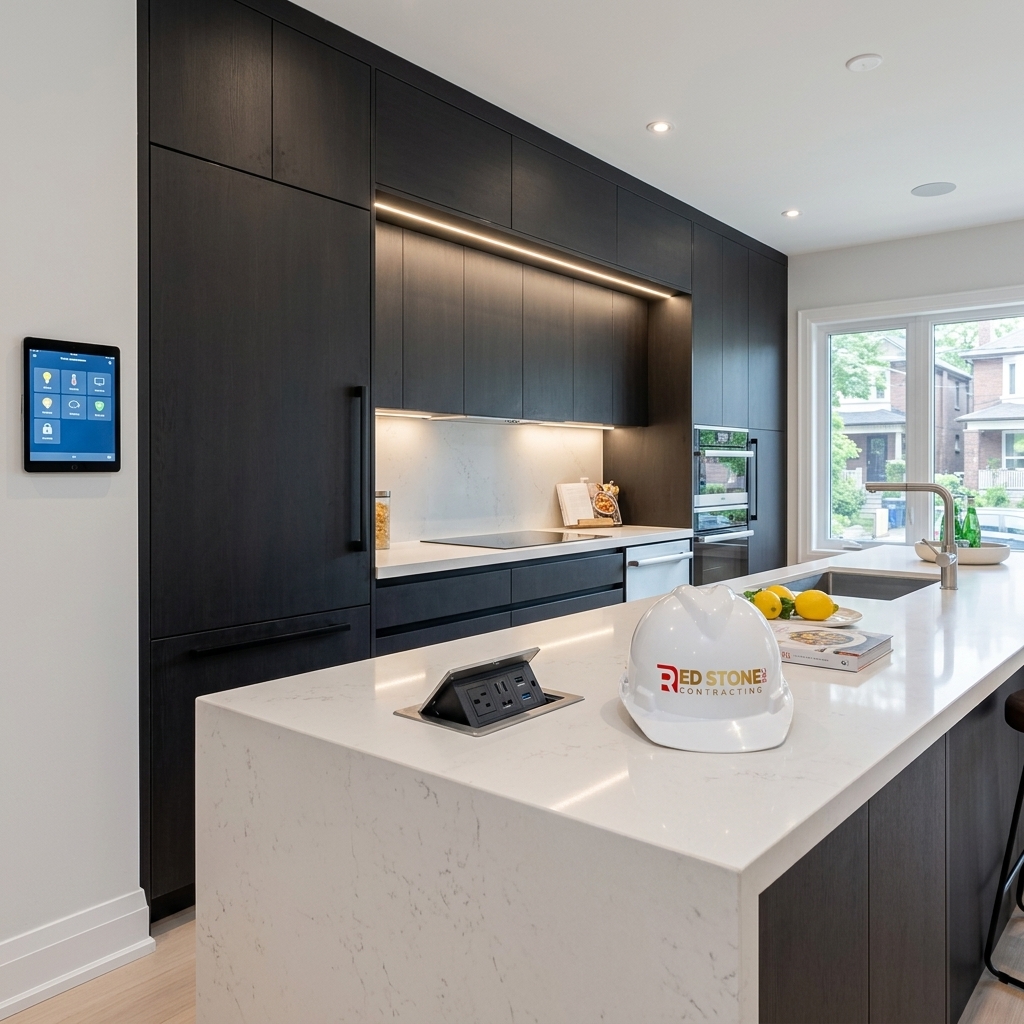
Heating and cooling account for approximately 60 percent of a Toronto home’s energy costs. Smart thermostats like the ecobee Premium or Google Nest Learning Thermostat use occupancy sensors, weather forecasts, and learning algorithms to optimize temperature schedules automatically, reducing energy consumption by 15 to 25 percent annually.
For homes undergoing major renovations, the opportunity exists to install a zoned HVAC system with motorized dampers in the ductwork and individual thermostats for each zone (typically one per floor). This allows precise temperature control — keeping bedrooms cool at night while maintaining comfortable temperatures in living areas during the day — and eliminates the common complaint of uneven heating in multi-storey Toronto homes.
| Climate Technology | Cost Installed | Annual Energy Savings |
|---|---|---|
| Smart Thermostat (Nest/ecobee) | $350 – $500 | 15% – 23% on heating/cooling |
| HVAC Zoning System (3-zone) | $3,000 – $6,000 | 20% – 30% on heating/cooling |
| Smart Radiator Valves (per unit) | $80 – $150 | Variable — best for radiator-heated older homes |
| Smart Ceiling Fans with integrated lighting | $400 – $800 per unit | Reduces AC dependency in summer |
Security and Monitoring Integration
A renovation is the ideal time to install a comprehensive, hardwired security system rather than relying on battery-powered wireless cameras that require frequent charging and depend on Wi-Fi stability. During the open-wall phase, your contractor can run ethernet cables to strategic camera mounting locations — front door, rear yard, garage, side passage — ensuring reliable, high-resolution 24/7 recording without Wi-Fi interference or battery limitations.
- PoE (Power over Ethernet) cameras: Receive both power and data through a single ethernet cable. No separate power adapters needed. Systems from Reolink, Ubiquiti, or Hikvision cost $150 to $400 per camera.
- Smart locks: Keyless entry via code, fingerprint, or phone app. Models from Schlage, Yale, and August range from $250 to $500 installed.
- Video doorbell (hardwired): Ring Pro 2 or Google Nest Doorbell (wired) provide consistent power and do not require battery charging. $200 to $350 installed.
- Smart smoke and CO detectors: Interconnected devices that alert your phone and announce the specific room where smoke is detected. Google Nest Protect costs approximately $170 per unit.
Motorized Window Treatments and Audio
Motorized blinds and shades add a luxury feel that buyers increasingly expect in premium Toronto homes. During renovation, low-voltage wiring or power outlets can be installed inside the window frame header to power motorized roller shades. Systems from Lutron Serena or Hunter Douglas PowerView integrate with smart home platforms and can be automated to adjust based on time of day, sunlight intensity, or temperature.
Whole-home audio systems like Sonos or dedicated in-ceiling speaker systems can also be planned during renovation. Running speaker wire to key rooms (kitchen, living room, master bedroom, bathroom, outdoor patio) during the open-wall phase costs $100 to $200 per speaker location, while in-ceiling speakers cost $200 to $500 per pair installed. The result is invisible, high-quality audio throughout the home without visible speakers or cable clutter.
EV Charging and Electrical Panel Upgrades
With electric vehicle adoption accelerating rapidly across the GTA, installing EV charging infrastructure during a renovation is one of the smartest future-proofing decisions a Toronto homeowner can make. A Level 2 EV charger requires a dedicated 240-volt, 40-to-50-amp circuit from your electrical panel to the garage or driveway. Running this circuit during renovation — when walls are open and the electrician is already on-site — costs $800 to $1,500. Retrofitting the same circuit after construction is complete typically costs $2,000 to $3,500 due to the difficulty of routing heavy-gauge wire through finished walls and ceilings.
Many older Toronto homes operate on 100-amp or 125-amp electrical panels that were designed decades before smart homes, EV chargers, induction cooktops, and heat pumps existed. A renovation is the ideal time to upgrade to a 200-amp electrical panel, which provides sufficient capacity for all modern electrical loads including future additions. Panel upgrades cost $2,500 to $4,500 and require a licensed electrician and an ESA (Electrical Safety Authority) inspection.
Future-Proofing Your Renovation
Technology evolves rapidly, but the wiring and infrastructure inside your walls should last 30 years or more. Future-proofing strategies include running empty conduit tubes to key locations (home office, living room, garage) that allow new cables to be pulled in the future without opening walls. Installing deeper electrical boxes at TV mounting locations accommodates future device changes. Pre-wiring for outdoor cameras, landscape lighting, and gate automation ensures these features can be added later with minimal disruption.
The emerging Matter protocol — jointly developed and backed by Apple, Google, Amazon, and Samsung — is creating a unified smart home standard that allows devices from different manufacturers to communicate seamlessly without proprietary hubs. By choosing Matter-compatible devices during your 2026 renovation, you ensure your smart home ecosystem remains fully compatible and easily expandable as innovative new devices enter the market over the coming years.
Total Smart Home Integration Budget
| Integration Level | What Is Included | Budget Range |
|---|---|---|
| Essential | Structured wiring (8-10 drops), smart thermostat, 15 smart switches, hardwired doorbell camera, smart lock | $5,000 – $10,000 |
| Comprehensive | Full structured wiring (16+ drops), whole-home Lutron lighting, 4+ PoE cameras, zoned HVAC, motorized blinds (5 windows), multi-room audio (4 zones) | $15,000 – $30,000 |
| Premium/Custom | Enterprise networking, Lutron RadioRA3 or Crestron, full security system with NVR, motorized blinds throughout, dedicated home theatre, outdoor audio and landscape lighting automation | $35,000 – $75,000+ |
How much does it cost to make a Toronto home a smart home during renovation?
Should smart home wiring be installed during or after renovation?
What is the best smart lighting system for a whole-home renovation?
Do smart home features increase property value in Toronto?
Can I add smart home features to my Toronto home without a full renovation?
Which smart home systems work together?
Build Your Smart Home with Red Stone Contracting
Integrating smart home technology is not a standalone project — it is a layer that must be woven into every phase of your renovation, from design through construction through final commissioning. Our team coordinates with technology integrators and electricians to ensure that the right wiring, the right devices, and the right control platforms are planned from day one and executed flawlessly during construction.
Whether you are planning a single-room refresh or a whole-home transformation, we ensure your renovation is future-ready with technology infrastructure that will serve you for decades. Call us at (905) 901-1006 or schedule your consultation online.
Red Stone Contracting delivers technology-forward renovations across Toronto, Oakville, Burlington, and Mississauga. We build homes that are as intelligent as they are beautiful.